
Which Team Will Be The Champion In The 2026 World Cup? Share Your Opinion (Vote)

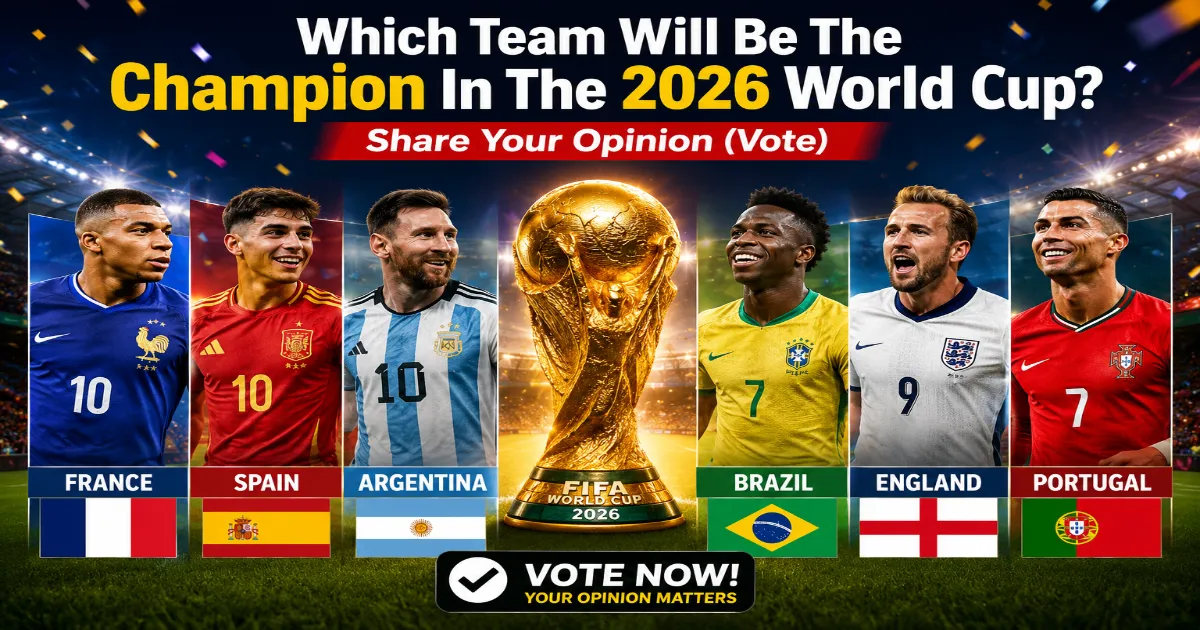
Okay, I’ll be honest I’ve been obsessing over this question for weeks. Every morning I check the latest odds, read a new expert take, and somehow end up more confused than before. The 2026 FIFA World Cup kicks off on June 11, and with six nations genuinely capable of lifting that trophy, picking one feels almost unfair. But that’s exactly the point of this piece.
I want your take not just mine. Cast your vote below, and then read why each contender is either overrated, underrated, or exactly what the data says they are.
Before you scroll to the poll, let me walk you through what I found when I dug past the surface-level predictions. Some of it surprised me. Some of it confirmed my gut. And one thing genuinely changed my mind about a team I’d written off entirely.
The Current Odds LandscapeAnd Why I Think They’re Slightly Off
Most articles just list the odds and move on. I disagree with that approach, and here’s why raw numbers without context are almost meaningless in a tournament as chaotic as the World Cup.
Spain sit at the top of the market as the +430 favorite, just edging out France at +500, with England at +650 rounding out the top three. Brazil (+800) are the biggest non-European contender. That’s the headline figure. But here’s what caught my attention.
When Lamine Yamal was ruled out for the remainder of Barcelona’s season with a torn hamstring, tournament projections changed almost instantly. Spain slipped from the clear favorite position and found themselves level with France in many expert rankings. Now, with growing optimism about Yamal’s recovery, Spain has reclaimed the top spot. It’s remarkable how one teenager’s fitness can reshape expectations for an entire World Cup.
At prediction markets specifically, France leads at +485 (17.1% implied probability), with Spain at +490 (17.0%) and England at +796 (11.2%). Those two top figures are so close they’re essentially a coin flip. And that, honestly, is the most honest read of this race.
Nobody not the oddsmakers, not the pundits truly knows. The World Cup winner contract alone has generated $452.2 million in trading volume across Kalshi and Polymarket. Half a billion dollars in uncertainty. That matters. A lot.
If you’re forming your vote right now, don’t go purely with whoever’s top of the odds board. Instead, cross-reference two or three different platforms and look at the trend lines, not just today’s number. It takes ten minutes and gives you a much sharper picture.
| Team | DraftKings Odds (May 29) | UK Bookmaker Odds (May 2026) | Prediction Market Implied % |
|---|---|---|---|
| Spain | +475 | 9/2 | ~17.0% |
| France | +500 | 13/2 | ~17.1% |
| England | +650 | 6/1 | ~11.2% |
| Brazil | +850 | 8/1 | ~9.1% |
| Argentina | +900 | 8/1 | ~8.6% |
| Portugal | +1000 | 11/1 | ~7.2% |
Spain and France: Why This Two-Horse Race Is Real, Not Media Hype
I initially resisted the Spain-France co-favorite narrative. It felt too convenient. Two big European brands, easy to sell. But when I actually compared their squads side by side, the gap between them and everyone else is larger than most expect roughly 5–8 percentage points of implied probability separating them from England in third place.
Spain’s top talents include Pedri, Lamine Yamal, and Rodri a core that blends elite playmaking with scoring depth. They’ve appeared in 16 previous World Cups and won it once, in 2010. They also won the 2024 Euros. That back-to-back tournament dominance isn’t accidental. Spain’s European Championship triumph wasn’t a one-man show Dani Olmo, Rodri, and Fabian Ruiz combined to play a style reminiscent of their tiki-taka glory years from 2008 to 2012.
France, though? That’s where it gets genuinely interesting. France enters with Kylian Mbappé as the star player, with the 26-year-old just five goals shy of passing Miroslav Klose’s record for most career World Cup goals. They’ve made 16 previous World Cup appearances and won the title twice in 1998 and in 2018. And Mbappé isn’t arriving alone. The Real Madrid forward notched 42 goals at club level during 2025–2026, and he’ll be supported by 2025 Ballon d’Or winner Ousmane Dembélé and Michael Olise, who combined for 83 goal involvements across all competitions last season.
Personally, I’d lean France over Spain, primarily because tournament pedigree at this level matters and Les Bleus have played in each of the last two World Cup finals, beating Croatia in 2018 and losing on penalties to Argentina in 2022. They contested three of the previous five finals. That final-stage mentality is hard to manufacture. Cast your vote and tell me if you see it differently.
Argentina and Brazil: The South American Case That Keeps Getting Dismissed
Most coverage this cycle has treated South American contenders as afterthoughts. I noticed that too, and it bothered me because the numbers don’t support that dismissal at all.
Argentina arrive as defending champions with much of the 2022 core still intact. Messi, now 38, may not start every match, but Lautaro Martínez gives them a reliable finisher beyond the old guard. Their Group J draw against Algeria, Austria, and Jordan looks kind. Reigning champion Argentina, led by Lionel Messi, are at +950 as they seek to become the first back-to-back winners since Brazil in 1962. That’s a piece of history nobody’s talking about enough.
Brazil’s situation is trickier, and I’m genuinely not sure whether their ceiling or their floor matters more here. They start a new era under Carlo Ancelotti. Vinicius Jr. and Raphinha give them pace, flair, and genuine match-winning quality, while Group C against Haiti and Scotland offers a friendly opening. The doubt is cohesion Ancelotti is elite at club level, but international football gives him far less time to build rhythm. That’s the precise tension that makes Brazil fascinating and frustrating simultaneously.
Actually, let me rephrase that. The question isn’t whether Brazil has talent obviously they do. The question is whether a manager celebrated for managing egos at Real Madrid can compress months of club-level chemistry into a few weeks of international camp. The data I found points both ways, honestly. Brazil’s aging midfield does not inspire confidence, and Ancelotti may not have the lineup figured out by the group opener against Morocco. Yet their attacking ceiling remains sky-high. Before you vote for or against them, ask yourself how much do you trust a brand-new manager in a brand-new international role?
England and Portugal: The Contenders Everyone Overlooks Until It’s Too Late
Look, England fans have heard “this is their year” approximately seventeen times. I get the skepticism. But the counterintuitive thing about England in 2026 that nobody’s discussing openly their squad depth under a new manager might actually be a structural advantage, not a liability.
England’s key players include Harry Kane, Jude Bellingham, and Declan Rice forming one of the nation’s strongest generations in decades. They’ve reached 16 previous World Cups and won the trophy once, in 1966. Under Thomas Tuchel, England are priced at 6/1 to 11/2 depending on the operator, placing them among the top three favorites with their squad depth and tournament draw giving them a realistic chance of reaching the latter stages for the first time since 1990. That’s not nothing.
Portugal, though, is the team I personally underestimated the most when I started this research. They don’t have the trophy-winning track record of the others they’re the only one of the six without a World Cup title. The population of Portugal is roughly the same as the Dominican Republic and yet they’re legitimately grouped among the six possible winners. That’s extraordinary when you think about it. With Bruno Fernandes and João Félix leading a strong squad, and Roberto Martínez bringing tactical stability, they offer real value at 11/1.
The surprising angle nobody mentions: Portugal’s biggest weakness is actually what used to be their biggest strength since the start of 2024, Cristiano Ronaldo has scored 26% of Portugal’s non-penalty goals and generated 37% of their expected goals in competitive matches. An over-reliance that cuts both ways genius on good days, a structural vulnerability on bad ones.
A simple rule I follow: when a team’s ceiling and floor are this far apart, always wait for the group stage to show you which version has turned up before drawing conclusions.
The Expanded 48-Team Format Why This World Cup Is Genuinely Harder to Predict
Here’s something that gets glossed over in the “who wins” conversation the format itself changes the math in ways that hurt favorites, not help them.
The 2026 FIFA World Cup will be the first edition with 48 teams, 104 matches, and three host countries the United States, Canada, and Mexico. The tournament opens June 11, with the group stage running through June 27, before the round of 32 sets on June 28 and from there, the knockout games intensify all the way to the final on July 19 in New Jersey. That’s a longer road than any previous edition. Which matters. A lot.
In six different World Cups this century, we’ve seen at least one major favorite exit during the group stages in every single one. Now add an extra knockout round to the picture. If each of the six favorites has a 90% chance of advancing from their group, multiply that across all six and there’s roughly a 47% chance at least one goes home before the knockout rounds even start. So nearly a coin-flip chance that a top-six team flames out in the group stage. Spain themselves went home after three group matches in 2014 as defending world champions. Germany followed suit in 2018, defending their title by finishing last in their group. These aren’t flukes. They’re the pattern.
Before you lock in your vote, consider this: the winner of this tournament won’t just be the most talented team. The team most likely to win will be the one that combines elite talent with recovery, tactical flexibility, and enough depth to survive seven or eight demanding matches across three different countries. That filter alone might change how you think about this. Check your favorite team’s squad depth chart before finalizing your pick it takes five minutes and reframes the entire question.
Cast Your Vote: Which Team Takes the 2026 World Cup Trophy?
Alright this is the section I’ve been building toward. I’ve read the odds, dug into the squad data, and shared where I agree and disagree with the consensus. Now it’s your turn. Below are the six teams I believe have a genuine shot at lifting that trophy at MetLife Stadium on July 19.
I want your honest opinion not the safe pick, not the fashionable choice. Which team do you actually believe goes all the way? Vote, then drop a comment explaining your reasoning. I read every single one, and the responses from previous polls genuinely shaped how I think about this stuff.
And here’s the thing I’ve seen polls shift dramatically in the final days before tournaments begin. The same users who voted “Spain” three weeks ago started migrating toward “France” the moment Yamal’s injury news broke. That movement tells its own story. Sure, perfectly consistent on paper.
What I’m genuinely curious about are your readers leaning toward the statistically backed favorites, or do emotional connections (your country, your club’s players, the narrative) drive more of these votes? Drop your answer below.
The one thing worth doing right now: vote before the tournament kicks off on June 11, then revisit this page after the group stage watching your prediction hold up or crumble in real time is half the fun.
Final Thoughts
The most important thing I took from this research isn’t a team name it’s that the margin between the top six contenders is genuinely razor-thin, with Spain and France separated by less than one percentage point in prediction markets, and four other nations all sitting within realistic striking distance of the final.
Personally, I’d back France their final-stage experience and Mbappé’s prime-age form are hard to argue against. But I’d love to be proven wrong by an Argentina or England run that nobody saw coming. Vote, share this with a football obsessed friend, and let’s find out together.
Related Articles
Who Is The Best Player In This World Cup 2026? Give Your Opinion/Vote
Here’s the thing, I’ve read through a lot of World Cup preview content over the past few weeks,…
Who Will Win The Golden Boot At FIFA World Cup 2026? Give Your Opinion/Vote
Honestly, I’ve spent the last few weeks obsessing over this exact question. The FIFA World Cup 2026 is…