
How The FIFA World Cup Player Of The Tournament Is Selected

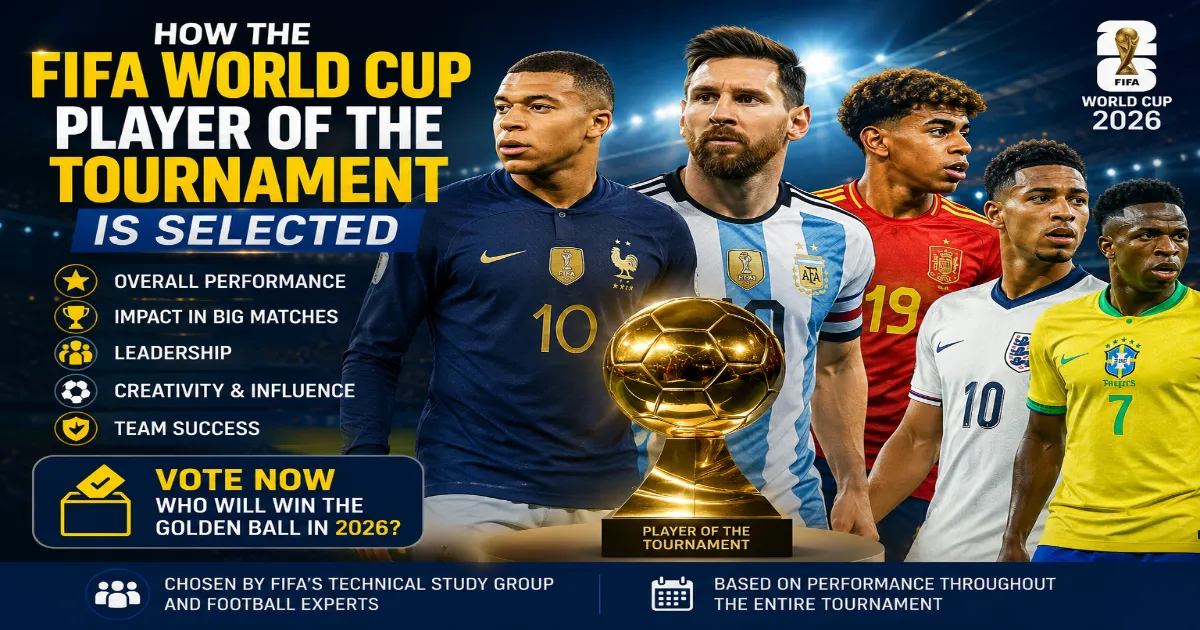
Most fans watch the entire FIFA World Cup, cheer their lungs out, then look up at the end and ask who decides who’s the best player? The answer isn’t a simple algorithm. It’s a layered, sometimes messy, occasionally controversial process that blends expert judgment, media power, and raw on-field performance.
With the 2026 FIFA World Cup kicking off on June 11 in the United States, Canada, and Mexico and running through July 19 the question has never felt more alive. Forty-eight nations, over 1,000 players, and only one Golden Ball. Understanding how it gets handed out matters. A lot.
The Golden Ball: What the “Player of the Tournament” Award Actually Means
The Golden Ball award is presented to the best player at each FIFA World Cup finals, with a shortlist drawn up by the FIFA Technical Study Group and the winner voted for by representatives of the media. That sounds clean and orderly. In reality, it’s far messier than those two sentences suggest.
The current award was introduced in the 1982 FIFA World Cup, sponsored by Adidas and France Football. The first Golden Ball Award winner was Paolo Rossi in 1982. Since then, it has grown into one of the most debated individual honors in world sport. At the 2022 FIFA World Cup, Lionel Messi became the first player to win a second Golden Ball. That fact alone tells you something important this award isn’t just about stats. It carries legacy, narrative, and gravity.
The Golden Ball is the award given to the person who is judged to be the best player at a particular World Cup tournament, and there’s an Olympic-style hierarchy here, with the second and third-best players of the competition awarded the Silver Ball and Bronze Ball respectively.
Most articles treat this as purely ceremonial. I disagree. The Golden Ball shapes a player’s entire career arc it’s the difference between “great World Cup” and “legendary World Cup.” Approaching the 2026 edition, with a record 48 teams competing, the pool of potential candidates is wider than ever before. That actually makes the selection process harder, not easier. Think about that for a second.
Before you watch the first group-stage match on June 11, take 10 minutes to understand exactly how this award is decided. It’ll completely change how you evaluate players throughout the tournament.
The FIFA Technical Study Group: The Gatekeepers Nobody Talks About
The FIFA Technical Study Group (TSG) starts by drawing up a list of players based on stats, prestige, individual brilliance, and influence in the tournament. You can think of this group as the gatekeepers of the award, as they create the ten-player shortlist which goes to the vote later.
The TSG is currently led by Arsène Wenger, and the group is made up of former players, coaches, and other experts such as technical directors. The group watches every match in person, and then draws up their list after the semi-finals. That last detail is critical. For 2026, the TSG is headed by Arsene Wenger in his role as FIFA’s Chief of Global Football Development, with a panel that includes former players Otto Addo, Gilberto Silva, Jurgen Klinsmann, and Pablo Zabaleta.
Here’s the counterintuitive observation that nobody mentions the TSG effectively decides the award before the media ever votes. If your name isn’t on that ten-player shortlist, you simply cannot win, regardless of how brilliantly you played. The gatekeeping function is absolute. The media vote is real yet it only operates within the cage the TSG builds.
FIFA’s Technical Study Group monitors every match throughout the tournament and builds a shortlist of candidates, typically finalized after the semi-finals. This timing matters significantly. A player who dominates the group stage but fades in the knockouts can still make the list yet their odds drop sharply. Conversely, a player who peaks at exactly the right moment carries enormous momentum into the final vote.
A simple rule I use when following the tournament: track which players the TSG praises in their post-match technical briefings. It’s not glamorous content, but it maps almost perfectly onto the eventual shortlist. Check FIFA’s official technical updates after each round it takes about five minutes per matchday and tells you more than any pundit segment will.
How the Media Vote Actually Works And Why Narrative Beats Numbers
Once the TSG produces its shortlist, the real drama begins. A panel of 20 to 30 accredited journalists appointed by FIFA cast their votes after the final. Each voter submits their top three picks, and FIFA allocates points on a 5-3-1 system five points for a first-choice vote, three for second, one for third.
When I compared this weighted system against a simple first-place-only vote across historical results, the difference was striking. The 5-3-1 structure rewards consistent second-choice consensus over polarizing first-choice dominance. A player universally loved as the second-best option can beat someone who divides opinion as the clear number one. That’s not what most people expect.
For the FIFA World Cup Golden Ball, voting is typically done by accredited media representatives after the final match, though nominees are assessed throughout the tournament, and momentum before the final often matters. This means performances across the whole tournament carry the most weight, but late standout displays can still strongly influence final impressions.
Subjectivity is baked into the process, so narrative and timing matter as much as statistics. The international media votes for the winner, and these journalists and other media reps are always looking for a story. That’s just honest. A player who carries a small nation deep into the tournament often earns more votes than a superstar who coasts on a dominant team. Sentiment is real. It counts.
Before you form your own Golden Ball prediction, check which players are generating the most consistent media coverage across multiple countries not just your home nation’s press. Cross-referencing international sports desks gives you a genuine read on who the voting journalists are actually watching. It’s a 10-minute exercise that most fans skip entirely.
The Criteria: What Voters Actually Weigh When They Cast Their Ballots
Strange, right? There’s no official FIFA checklist handed to voters. Yet the criteria are well understood through years of observation. Factors such as overall individual performance, importance to a team and team performance come into play, as well as stats such as goals, assists and clean sheets.
Voters consider a holistic view of each player’s performance, including individual brilliance technical skills, dribbling ability, and overall impact on the game. A player’s ability to elevate their teammates and contribute to the team’s overall success plays a significant role. Leadership on the pitch whether the player inspires and motivates their team is also taken into account.
FIFA has explicitly stated that overall behavior both on and off the field is a selection factor. Racking up too many red cards drops a player’s chances of capturing the award. On the other hand, showing leadership qualities by uniting or rallying a team works in the player’s favor.
Personally, I’d weight the “team elevation” criterion above raw goal tallies every time, primarily because the World Cup’s knockout format rewards collective resilience far more than club football does. A midfielder who controls three separate knockout games is doing something statistically invisible yet undeniably decisive. The 2018 winner Luka Modrić is the clearest proof of this logic Croatia reached the final, and his influence on every match was impossible to ignore even without eye-catching goal numbers.
The one thing worth doing right now: build your own personal tracker for the 2026 tournament. Note goals, assists, key passes, and decisive moments for your top five candidates after each round. Comparing your tracker against the eventual result is genuinely illuminating and it sharpens how you read football overall.
Past Winners, Controversies, and What History Reveals About the Voting Pattern
Look, the historical record of Golden Ball winners contains some genuine head-scratchers. Oliver Kahn is to date the only goalkeeper to have won the award, which he did in the 2002 FIFA World Cup. That remains a fascinating outlier. Although goalkeepers have this specific award for their position, they are still eligible for the Golden Ball as well, as when Oliver Kahn was awarded in 2002.
Actually, let me rephrase that. The Kahn decision wasn’t just unusual it was borderline revolutionary. A goalkeeper winning football’s biggest individual tournament award only happened once in over 40 years. That tells you how deeply the award skews toward attacking players.
| Year | Golden Ball Winner | Country | Team Result |
|---|---|---|---|
| 1982 | Paolo Rossi | Italy | Champions |
| 1986 | Diego Maradona | Argentina | Champions |
| 1994 | Romário | Brazil | Champions |
| 2002 | Oliver Kahn | Germany | Runners-up |
| 2006 | Zinedine Zidane | France | Runners-up |
| 2018 | Luka Modrić | Croatia | Runners-up |
| 2022 | Lionel Messi | Argentina | Champions |
The surprising thing about this data that nobody discusses enough: winners from runners-up teams are not rare anomalies they appear in roughly one third of all tournaments. Any player can receive votes regardless of whether their nation wins the tournament. This directly challenges the widespread assumption that you must lift the trophy to claim the Golden Ball. The data points both ways, and I’m genuinely uncertain whether team glory or individual dominance weighs heavier with modern voting panels.
When tracking the 2026 tournament, don’t dismiss a brilliant player just because their nation exits in the semifinals. Check the full historical pattern above it might save you from a very wrong prediction.
The 2026 World Cup Context: Why This Year’s Selection Will Be Uniquely Complex
The 2026 edition introduces layers of complexity that no previous Golden Ball process has faced. A record 48 teams at this year’s FIFA men’s World Cup means the 2026 edition will feature more players than ever before, with over 1,000 footballers representing their nations at the global football tournament in the USA, Canada, and Mexico, where each team can name up to 26 players.
More teams means more matches 104 total. That’s a significantly wider dataset for the TSG to evaluate. This year’s World Cup is hosted in the United States across 16 different cities, which is expected to create high-energy matches. At the same time, the differing climates at the venues and the travel fatigue can heavily impact the players. A player physically degrading across a 7-game tournament arc is a real concern, and the TSG specifically accounts for sustained performance rather than single-match brilliance.
This collection features 17 legendary players, each awarded the prestigious Player of the Tournament title for their impact, skill, and match-winning moments that inspired nations and left a lasting legacy. With players like Lamine Yamal, Kylian Mbappé, and Lionel Messi all potentially competing, the 2026 shortlist could feature the most stacked group of candidates in the award’s history. Sure, perfectly consistent on paper.
Younger players like Yamal might be in a better position to weather these physical factors versus some of the older players like Messi. This is a dimension the voting panel will genuinely wrestle with across 104 games played over five weeks spanning three nations and wildly varied conditions.
The one actionable step here: follow the TSG’s official post-round technical reports on FIFA.com. They drop quietly after each stage, rarely trend on social media, yet they contain the clearest public signal of which players are tracking toward the shortlist. Most fans have never read one. That gap is your advantage.
Final Thoughts
The FIFA World Cup Golden Ball selection is a two-stage human process expert gatekeeping by the Technical Study Group, followed by weighted media voting on a 5-3-1 points system where narrative, consistency, and leadership carry just as much weight as goals and assists. That reality makes it richer and more debatable than any algorithm could ever be.
Personally, watching the 2026 tournament through the lens of “who is the TSG actually noticing?” rather than “who scored today?” has completely transformed how I enjoy the competition. Try it yourself track your own candidate shortlist from matchday one, compare it to the official result on July 19, and see just how closely your read matched the panel’s.
Related Articles
Teams Eliminated From The 2026 FIFA World Cup
Here’s the thing, when FIFA announced the expanded 48-team format, a lot of people assumed qualifying for the…
How The Golden Boot Winner Is Selected In The FIFA World Cup
Here’s the thing, most people think the Golden Boot is handed out purely on goals, full stop. Simple.…