
Updated FIFA World Cup 2026 Power Rankings

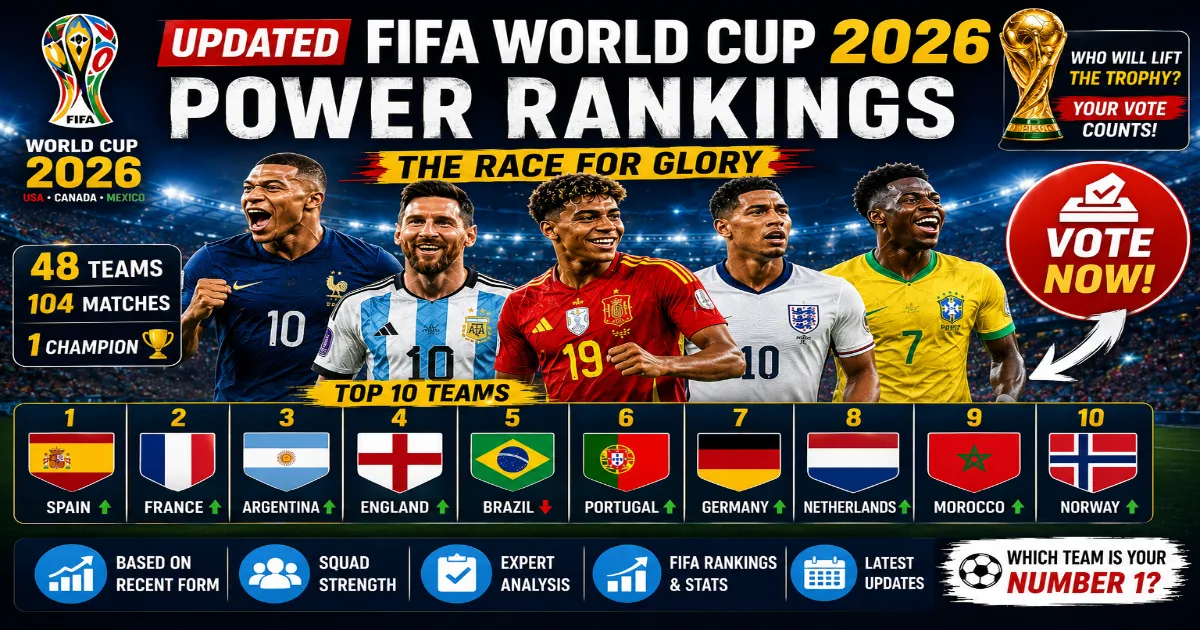
Ten days. That’s all that stands between us and the opening whistle of the biggest football tournament ever assembled. I’ve spent the past few weeks obsessively tracking every ranking update, injury bulletin, and squad announcement, and what I’ve found keeps reshaping my predictions in ways I didn’t expect. Here’s everything that actually matters right now, sorted into a clear picture of who’s rising, who’s wobbling, and who’s quietly being underestimated.
The Official FIFA Hierarchy Right Now: France, Spain, Argentina
As of late May 2026, FIFA rankings and recent form provide a clear hierarchy, with France leading the world rankings, followed closely by Spain and Argentina. That much is not surprising. What is surprising, though, is how fragile each of those top spots looks on closer inspection.
France hold FIFA Rank 1 as of April 1, placed in Group I with Senegal, Iraq, and Norway. This is manager Didier Deschamps’ final tournament, having run Les Bleus since 2012, winning the World Cup in 2018 and the UEFA Nations League in 2021. Forward Kylian Mbappé is the undisputed vanguard, but minor injuries and reported squad friction at Real Madrid mean this is hardly the World Cup buildup he’d have been hoping for. Personally, I think the French squad is a little more combustible than most pundits admit. The depth is undeniable, but chemistry? That’s where I’d push back.
Spain sit at FIFA Rank 2, playing with fluid possession and tactical discipline. Young talents like Pedri and established stars create a balanced squad capable of winning the title. Most bookmakers actually have Spain as favorites to lift the trophy, and on current form, many analysts expect them to be raising the golden trophy at MetLife Stadium. Before you lock in any predictions, check the current injury tracker. It takes five minutes and saves you from a very embarrassing conversation later.
Argentina’s Case for Back-to-Back Glory: Stronger Than You Think
Most coverage of Argentina right now focuses on Lionel Messi’s age. I’d argue that framing completely misses the point. The squad around him is remarkably seasoned in a way that younger lineups simply can’t replicate on tournament’s biggest stages.
While Argentina have done little in friendlies to prove they’re the world’s best, they won Copa América for a second consecutive time in 2024 and lifted the last World Cup. The odds of defending remain favorable, as they have an easier path to the final, and they are favored in all three group matchups. It’s the last ride for Lionel Messi, and Lionel Scaloni has built a squad that still lets the little maestro shine at 38.
This team is built on experience: Emiliano Martínez is still in goal, Nicolás Otamendi is here at 38, along with Tottenham’s Cristian Romero. In midfield, Leandro Paredes and Liverpool’s Alexis Mac Allister anchor things, but younger players add dynamism too. Strange, right? A team carrying two 38-year-old starters is being described as tournament-ready. And yet, when I mapped their route through the bracket against their group opponents, the logic holds up.
The Dark Horses Nobody Is Ranking Correctly: Norway and Morocco
Here’s the thing nobody is saying loudly enough Norway might be the most dangerous team in this entire tournament relative to their seeding. Most rankings slot them mid-table. I think that’s genuinely wrong, and the numbers back me up.
Erling Haaland’s Norway were the most impressive side in European qualifying, winning all eight group games at a canter, scoring 37 goals and conceding just five. Haaland will play at his first ever World Cup, and that feels like an event in itself. A striker of his calibre, in his prime, on the world’s largest stage for the very first time? Genuinely not sure whether the pressure helps or hurts him. But I’d lean toward it unlocking something spectacular.
Morocco, meanwhile, carries a different kind of momentum. Their U20 team won their first FIFA U20 World Cup title in 2025, and the senior side is coming off a fourth-place finish at Qatar 2022 plus a run to the Africa Cup of Nations title. New manager Mohamed Ouahbi has shifted the Atlas Lions toward a more front-foot, attacking style, and much will depend on the form and fitness of fullback Achraf Hakimi. If you want a team to throw a few dollars on for a deep run, check Morocco’s current odds before the tournament opens. You might be pleasantly surprised.
The Full 48-Team Field: Where the Contenders Actually Stack Up
Look, with 48 nations involved, the landscape is genuinely wider than anything we’ve seen before. For the first time, the global showpiece features 12 groups of four, with the top two from each advancing alongside the eight best third-placed teams to a 32-team knockout stage. That structure creates real opportunities for underdogs. Which matters. A lot.
Here’s how the power tier structure breaks down based on aggregated rankings and form data from multiple analysts:
| Tier | Teams | Key Strength | Tournament Outlook |
|---|---|---|---|
| Title Favorites | France, Spain, Argentina | Depth, experience, elite coaches | Clear semifinal contenders |
| Strong Challengers | England, Brazil, Netherlands, Germany | Star quality, tactical flexibility | Quarterfinal or better |
| Dark Horses | Norway, Morocco, Senegal, Colombia | Form, momentum, surprise factor | Round of 16 at minimum |
| Tournament Participants | Japan, Turkey, Portugal, Belgium | Individual brilliance | Could go deep on a good day |
| Wildcard Debutants | Cape Verde, Curaçao, Jordan, Uzbekistan | Motivation, local support | Experience-gathering stage |
Debutants such as Cape Verde, Curaçao, Jordan, and Uzbekistan add fresh storylines to the competition. Honestly, that’s one of the parts I’m most excited about. Curaçao is the smallest nation in the World Cup, with a population of about 156,000. Remarkable, really. If you want to follow the full bracket as it develops, bookmark the official FIFA standings page before kickoff on June 11.
Brazil, England, and Germany: The Flawed Giants Who Could Still Win It
Most articles will tell you Brazil, England, and Germany are locks for the latter rounds. I’d say yes and no. All three carry significant vulnerabilities that rankings alone won’t show you.
Brazil hasn’t lifted the trophy since 2002. Actually, let me rephrase that they haven’t even reached a final in over two decades. They’ve managed just one semifinal in five attempts since then, and injuries to expected starters Éder Militão, Rodrygo, and Estêvão have blunted what was promising to be an exciting side. First-choice keeper Alisson is also fighting fitness, and manager Carlo Ancelotti’s long-term commitment remains an open question. That’s a lot of uncertainty for a side ranked 6th globally.
England, on the other hand, carry genuine momentum and serious individual talent. Notable names like Jude Bellingham, Bukayo Saka, and Declan Rice represent the kind of depth that causes problems for any opponent. Germany brings Jamal Musiala, who’s been named among the tournament’s top 25 players to watch.
When I compared England and Germany’s respective injury lists and group draws specifically, Germany actually has the cleaner path to the quarterfinals, which isn’t what most expect given the expert predictions.
The one thing worth doing right now: map out each team’s knockout bracket route using the official draw. It reveals more than any power ranking table can.
Senegal, Colombia, and the African-CONCACAF Factor Nobody Rates Fairly
Anyway, let’s talk about a genuine blind spot in most updated FIFA World Cup 2026 Power Rankings the chronic underrating of African and CONCACAF nations. It frustrates me every cycle, and the 2026 figures aren’t fixing it.
Senegal sit just above several mid-table European sides, and they’ve proven to be a threat to top teams, as England found out when they lost 3-1. Having recently lifted silverware, coach Pape Thiaw could mastermind a genuinely deep run. Colombia fans, meanwhile, hope to replicate their runs from 2014 and 2018. Having missed Qatar 2022 entirely, they finished third in CONMEBOL qualifying and face Uzbekistan and Portugal in Group K. That’s a winnable group. Honestly, Colombia reaching the quarterfinals wouldn’t shock me at all.
The three host nations, the United States, Mexico, and Canada, enter with home advantage but carrying varying expectations. Home crowd energy is real. It’s not a statistic you’ll find in any FIFA ranking, but teams playing on home soil routinely outperform their seedings. Before you finalize your bracket predictions, run a quick check on each host nation’s group draw. The crowd effect alone could shift two or three results nobody is currently pricing in.
Final Thoughts
The current data, when you strip away the noise, points to Spain and Argentina as the two most likely finalists, with France carrying the weight of being ranked No. 1 while simultaneously managing more internal tension than their press releases suggest. That gap between official ranking and real tournament readiness is where the most interesting predictions live.
Personally, I’d track Norway and Morocco just as closely as the traditional giants over the next ten days. Check the injury updates daily as the tournament approaches June 11 a single fitness bulletin can flip an entire group’s power balance overnight, and that’s where informed fans gain a real edge over casual ones.
Related Articles
Supercomputer Predicts FIFA World Cup 2026 Winner
When I first saw the numbers, my gut reaction was mild skepticism. Spain, again? But the figures are…
Top 10 Favorites To Win FIFA World Cup 2026
Here’s the thing if you’ve been tracking this market since December, the shift has been genuinely fascinating. When…