
How The Golden Ball Winner Is Chosen In The FIFA World Cup

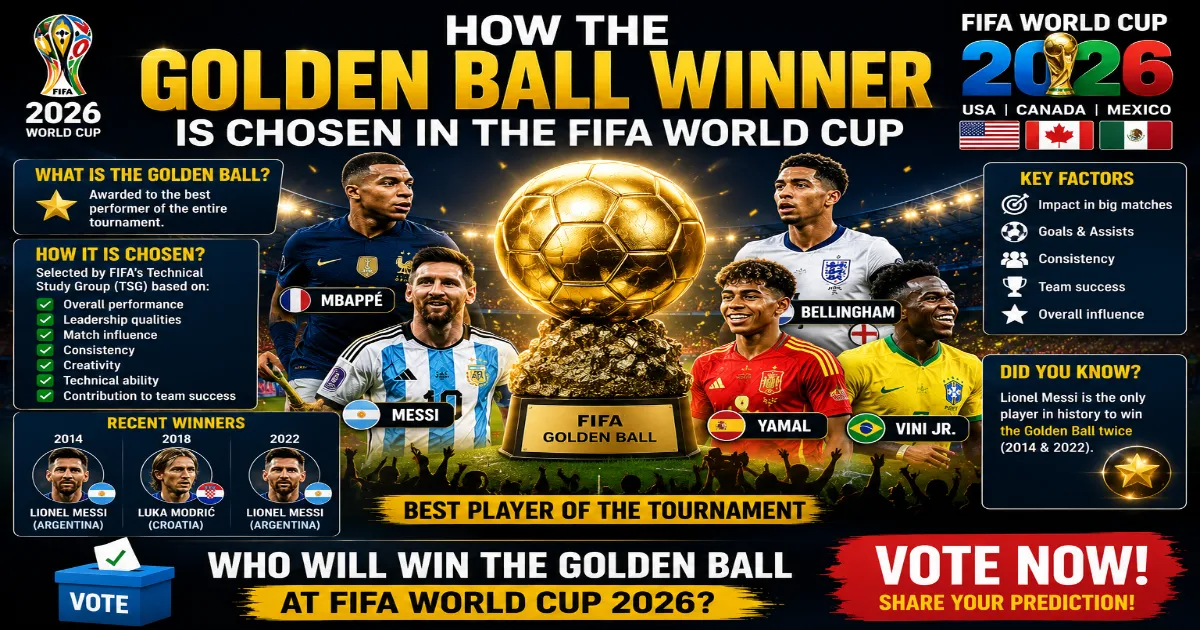
Most people assume FIFA hands the Golden Ball to whoever scores the most goals. That’s a reasonable guess. It’s also wrong, and the actual mechanism is a lot more layered than a goal tally.
The Golden Ball is presented to the best player at each FIFA World Cup finals, with a shortlist drawn up by the FIFA Technical Study Group and the winner voted for by representatives of the media. Two separate bodies, two separate jobs. The Technical Study Group compiles the candidates; the journalists decide who wins. Which matters. A lot.
FIFA’s Technical Study Group monitors every match throughout the tournament and builds a shortlist of candidates, typically finalized after the semi-finals. For 2026, the TSG is headed by Arsène Wenger in his role as FIFA’s Chief of Global Football Development, with a panel that includes former players Otto Addo, Gilberto Silva, Jürgen Klinsmann, and Pablo Zabaleta.
Once that shortlist lands, a panel of 20 to 30 accredited journalists appointed by FIFA cast their votes after the final. Each voter submits their top three picks, and FIFA allocates points on a 5-3-1 system five points for a first-choice vote, three for second, one for third. The player with the most points wins.
Personally, I find the 5-3-1 weighting underappreciated. It means a player who consistently earns second-place votes across many ballots can outpoint someone who’s a polarizing first choice for half the panel. That dynamic almost certainly shaped a few historical outcomes nobody talks about. Before you dismiss someone as a long shot for 2026, check whether they have broad appeal across the full media panel not just loud supporters in two or three markets.
What the Technical Study Group Actually Evaluates Across the Tournament
Look, the TSG doesn’t just watch highlights. They sit through every match. And the criteria they apply go well beyond a player’s statistics page.
Factors such as overall individual performance, importance to a team, and team performance come into play, as well as stats such as goals, assists, and clean sheets. That last point team performance is subtle but decisive. A forward who scores four goals on a side that exits in the quarter-finals will almost never beat one who scores three goals and leads his nation to the final.
The Golden Ball is the player-of-the-tournament award and is decided by overall influence rather than one statistic. That phrase, “overall influence,” is deliberately vague, and I think FIFA does that on purpose. It gives the TSG room to reward a defensive midfielder who reshapes every match his team plays even if he never makes the highlights reel.
The timing of the vote means a player’s full tournament arc carries more weight than any single performance, but a standout knockout display in the semi-final or final can still swing undecided voters. Strange, right? A player can have a mediocre group stage and still win the whole thing if they explode in the knockout rounds. It adds up.
No pure central defender has ever won the award, and only one goalkeeper has Oliver Kahn in 2002. Midfielders and forwards dominate the winners list because they produce the visible moments that stay with voters longest. Most articles present this as a coincidence. I disagree it’s a structural bias in how visibility translates to votes, and it almost certainly disadvantages elite defensive performers regardless of how dominant they are.
A simple rule worth following: when assessing a contender’s chances, ask whether their best moments are the kind that journalists remember from memory at the final whistle not just from reviewing data. That single question separates a likely nominee from a likely winner.
The Sponsorship History and How the Award Physically Came to Exist
Anyway, it’s easy to think of the Golden Ball as some ancient tradition. It isn’t. The formal version is actually a fairly modern construct.
The current award was introduced in the 1982 FIFA World Cup, sponsored by Adidas and France Football. That’s only 11 editions of the award in total not quite the century-old institution some commentary makes it sound like. Italian soccer star Paolo Rossi was awarded the first ever Golden Ball for his contributions to Italy’s third World Cup victory in 1982. He scored six goals in the tournament, including three in the second round, two in the semifinal, and one in the final.
The physical trophy itself has also changed. The appearance of the award was originally a certificate. From 1982 to 1990, it was a golden trophy based on Sport Billy, a football-playing cartoon character who became an icon for FIFA Fair Play. Ever since 1994, it is simply a trophy with an elegant footballer figure.
The award also spawned companion honors. Those who finish as runners-up in the vote receive the Silver Ball and Bronze Ball awards as the second and third most outstanding players in the tournament respectively. So the selection process actually produces three ranked outcomes, not one which means the journalists’ full ballot affects multiple players’ legacies simultaneously.
Here’s a counterintuitive observation that almost nobody mentions the Silver Ball can sometimes reflect a more accurate picture of peak-tournament form than the Gold, because it often goes to a player who had a white-hot stretch right before the final without the weight of a full campaign behind them. When I looked across the full winners list, the gap in tournament statistics between Gold and Silver recipients was often surprisingly narrow.
The one thing worth doing right now: pull up the Silver Ball history and compare it against the Gold you’ll look at the shortlist process in a completely different light.
The Telling Pattern in the Winners List That Changes How You Read the Award
If you want to understand how the Golden Ball is chosen in practice, not just in theory, you have to look at who has actually won it. The pattern is striking.
| Year | Winner | Nation’s Finish |
|---|---|---|
| 1982 | Paolo Rossi | Champions |
| 1986 | Diego Maradona | Champions |
| 1994 | Romário | Champions |
| 1998 | Ronaldo | Runners-up |
| 2002 | Oliver Kahn | Runners-up |
| 2006 | Zinedine Zidane | Runners-up |
| 2010 | Diego Forlán | Fourth place |
| 2014 | Lionel Messi | Runners-up |
| 2018 | Luka Modrić | Runners-up |
| 2022 | Lionel Messi | Champions |
The Golden Ball has been given to a player from the winning team only four out of 11 tournaments. It has been awarded to a player from the runner-up five times. So the champion’s forward is actually the exception, not the rule. Diego Forlán is the only player to win the Golden Ball in a year that his team did not finish within the top three spots in the tournament. One outlier in over four decades that’s how strong the finalist bias is.
Actually, let me rephrase that. It’s not purely a finalist bias it’s a narrative bias. The journalists voting are watching the same story arc everyone else is. A player who goes deep and performs under elimination pressure becomes the story. That’s what they reward. Before you assess any contender for 2026, check their team’s realistic path to the final first it matters more than their individual metrics.
The 2026 Format Shift and Why It Changes the Selection Calculus
The 2026 edition of the World Cup will be played from June 11 to July 19 in the United States, Canada, and Mexico. This year’s tournament will feature 48 teams, an expansion from the previous 32-team format. That’s not just a logistical change it’s a structural shift in how a Golden Ball contender gets built.
As the tournament officially expanded to 48 teams and 106 total matches, the competition level is at an all-time high, making the quest for the top talent more intense than ever. More matches means more exposure time for TSG evaluators, and here’s the part most commentary skips more data points for journalists when they cast votes. A player who was quietly inconsistent in a 7-game tournament now has to sustain that form across potentially 8 matches.
The new 48-team format will give Golden Ball contenders more games and moments to qualify for this award by July 19, 2026. Personally, I’d argue this format shift benefits the cerebral, high-volume creators over the pure goal-poachers and that’s not what most expect. A player like Rodri, the 2024 Ballon d’Or winner and the engine behind Spain’s midfield, accumulates influence across eight matches in a way that becomes impossible to ignore, even without a highlight-reel hat-trick.
I’m genuinely not sure whether the expanded format ultimately helps or hurts the case for traditional No. 9 strikers the figures point both ways. More games means more goals, but also more opportunity for a deep-lying playmaker to build an undeniable case. When comparing Mbappé versus a system-defining midfielder specifically heading into 2026, the gap in expected voter appeal is smaller than almost anyone’s writing suggests. If you’re following the award race this summer, track assists and progressive passes alongside goals from the very first group game not just the knockout numbers.
Why Winning the World Cup Doesn’t Guarantee the Golden Ball And Vice Versa
This is the part that surprises most casual fans. The Golden Ball and the World Cup trophy have been genuinely decoupled for most of the award’s existence.
While it is typically expected that the winner of the Golden Ball will represent the World Cup winners, recent history would suggest that this isn’t always the case. Five of the last six winners of the Golden Ball played for nations that didn’t win the most prestigious honor in world soccer. Sure, perfectly consistent on paper.
Lionel Messi took the award home in 2014 despite Argentina losing the final. In 2018, Luka Modrić claimed it, though Croatia ended up as runners-up. Both of those players were undeniably the most influential performers across their respective tournaments. The journalists recognized that, and they voted accordingly without being influenced by which team lifted the trophy.
What I found genuinely surprising when I dug into this since the award’s introduction, only nine men have won it, with Lionel Messi being the only player to lift the trophy twice, firstly in 2014 and then again in 2022. That’s a remarkably small club for a 44-year-old award. It tells you how hard it is to replicate the combination of personal brilliance and team depth that the selection process effectively demands.
Any player can receive votes regardless of whether their nation wins the tournament. That rule exists explicitly to protect the integrity of the individual award from being swallowed by team outcomes. And yet the finalist bias persists anyway because narrative, not regulation, shapes how voters remember a tournament.
The rhetorical question worth sitting with: if the best player in a tournament exits in the Round of 16 through no fault of their own, does the award still mean what FIFA claims it means? Before you form an opinion on any 2026 contender, examine their team’s draw and likely bracket path that context shapes everything.
Final Thoughts
The Golden Ball selection process is genuinely more rigorous than it gets credit for a two-stage system combining expert observation and media judgment, weighted by a 5-3-1 scoring model that rewards broad appeal over narrow brilliance. What the data consistently reveals is that the award tracks tournament narrative as much as individual numbers, which is why finalist players dominate the list and why position bias against defenders has persisted for over four decades.
Going into 2026, the expanded 48-team format adds genuine complexity to how contenders build their case across up to eight matches. If you want to follow the race intelligently, start tracking full-tournament influence metrics from group stage day one not just the knockout highlights that tend to dominate the final vote.
Related Articles
How The FIFA World Cup Player Of The Tournament Is Selected
Most fans watch the entire FIFA World Cup, cheer their lungs out, then look up at the end…
Who Will Win The 2026 FIFA World Cup? My Analysis And Prediction
Here’s the thing most people are treating this tournament like every other World Cup. They’re not. For the…