
Supercomputer Predicts FIFA World Cup 2026 Winner

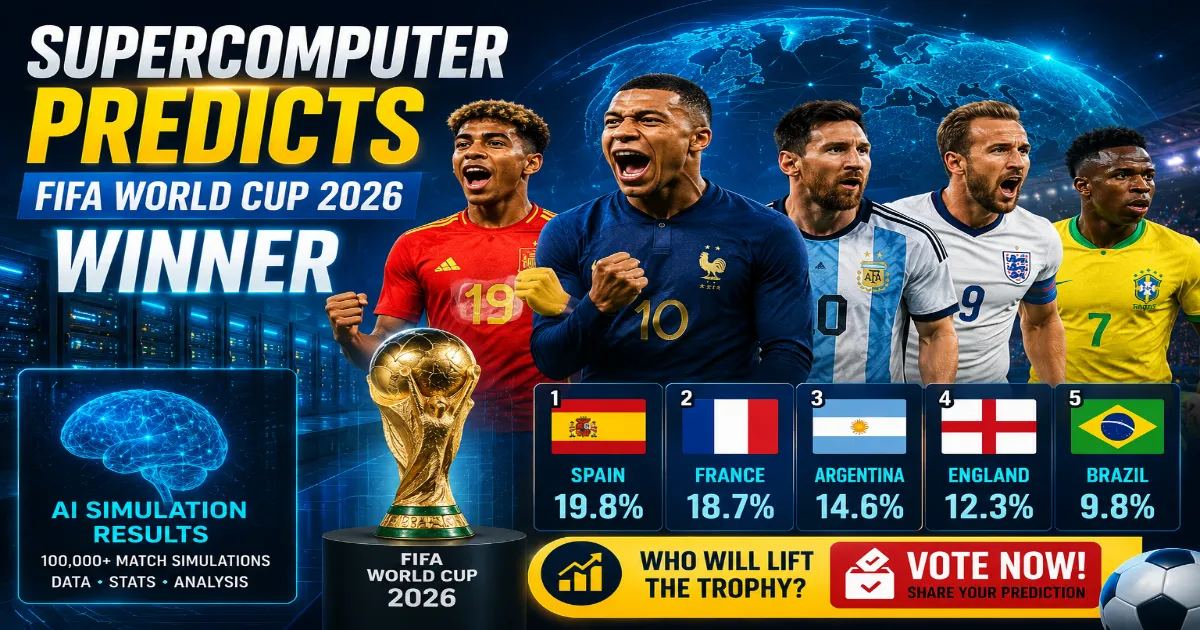
When I first saw the numbers, my gut reaction was mild skepticism. Spain, again? But the figures are hard to dismiss. Spain are the most likely winners of the 2026 World Cup, winning the tournament in 16.1% of the 10,000 pre-tournament simulations by the Opta supercomputer. That’s a clear gap from the chasing pack in a field this wide.
Most articles stop there. I don’t. The counterintuitive thing worth noting Spain tend to perform better in the Euros than at World Cups and that 2010 South Africa triumph represents the only time they reached the semi-finals from their last 14 World Cup participations. Strange, right? A team handed the top probability has actually been underperformers on this specific stage for over a decade.
Led by Barcelona stars such as Lamine Yamal, Pedri and Fermín López, Spain have been given a 16.02% chance of winning the tournament having last lifted the trophy in 2010 before going through a difficult period, though under coach Luis de la Fuente they are once again considered among football’s elite. That rebuild under de la Fuente is real. The squad depth is genuinely frightening.
Rodri is fit again and set to captain the side, while Mikel Oyarzabal and Mikel Merino were among the standout performers in qualifying. That midfield engine, paired with Yamal’s brilliance, gives them a profile no other team can match on paper. Which matters. A lot.
Personally, I’d lean Spain as the logical pick here primarily because their squad balance at every line is tighter than anyone else’s. Before you write off their World Cup record, look at the current generation’s architecture. It’s genuinely different from 2014 or 2018.
France and England: The Two Teams Breathing Down Spain’s Neck
Look, France being second comes as no surprise to anyone who watched Qatar in 2022. But the specific numbers from the simulation reveal something most coverage glosses over. France carry a 13% chance of winning the World Cup ranking only behind Spain’s 16.1% while England complete the podium with an 11.2% shot, and defending champions Argentina sit fourth on 10.4%.
The gap between France and Spain is around three percentage points. That’s not massive. Les Bleus’ chances improve significantly in the knockout stages, with the supercomputer giving them a 21% probability of reaching the final. That’s a fascinating detail they’re actually better finals material than their overall win percentage suggests. Actually, let me rephrase that France are built for late-tournament football. Their engine switches on when the stakes get existential.
France have reached the World Cup final in the past two editions winning in Russia in 2018 but losing the 2022 edition to defending champions Argentina. Two consecutive finals. That’s a level of consistency no algorithm can ignore.
England, though the Opta supercomputer favours them with an 11.2% chance, having reached the semi-final and quarter-final in the past two editions. Harry Kane and Declan Rice anchor a side that looks ready to convert near-misses into something real. When I compared England’s squad depth now against their 2018 and 2022 groups, the difference in cohesion is substantial not what most expect from a team with no major title since 1966.
A simple rule I follow: when two or three teams are within five percentage points of each other in a 10,000-simulation model, treat it as a coin flip past the quarterfinals. Bookmark the Opta Analyst page and check the updated projections once the group stage kicks off.
Argentina’s Title Defence: Historic Ambition Meets Brutal Odds
Defending a World Cup is a near-impossible task. The numbers reinforce that reality bluntly. Argentina is looking to become the first team to defend its crown since Brazil in 1962 which would be a remarkable achievement given there has been a different winner at each tournament since the turn of the century.
The defending champions are aiming for a fourth consecutive international title, having won the past two Copa Americas on either side of the 2022 World Cup and La Albiceleste carries a 10.4% chance of retaining their title. That Copa America double is evidence of genuine dynasty-level form, not a one-tournament fluke.
Then there’s Messi. The 10.4% chance also comes with the emotional weight of giving Lionel Messi a grand sendoff with Julián Álvarez and Nico Paz named as key players to watch alongside him. I’m genuinely not sure whether the emotional narrative around his farewell helps or hurts Argentina’s focus. Great teams thrive on clarity of purpose, and sentiment can cloud that edge.
According to one supercomputer model, France, Spain, Brazil and Argentina were projected to reach the semi-finals setting up a France vs. Spain clash and a Brazil vs. Argentina reunion. That semifinal bracket, if it materializes, would be the most watched set of matches in football history. Yet the numbers say Spain beats Argentina in the final.
| Team | Win Probability (Opta) | Key Player |
|---|---|---|
| Spain | 16.1% | Lamine Yamal |
| France | 13.0% | Kylian Mbappé |
| England | 11.2% | Harry Kane |
| Argentina | 10.4% | Lionel Messi |
| Portugal | 7.0% | Cristiano Ronaldo |
| Germany | 5.84% | Florian Wirtz |
If you’re tracking Argentina’s path, check their group assignment and knockout draw carefully before the tournament’s third week. The route matters as much as the team’s quality at this level.
Germany, Portugal and the Contenders Everyone Is Underestimating
Germany’s situation is one the supercomputer handles with cautious optimism. It’s been 12 years since they played a World Cup knockout game and Julian Nagelsmann’s side have appeared at four consecutive major tournaments without a semi-final yet Germany may need a big showing from Liverpool’s Florian Wirtz, and the supercomputer still gives them a 5.84% win probability. Overdue. Genuinely.
Portugal is the curious case here. Cristiano Ronaldo is competing in what is widely considered his final World Cup tournament one last chance to win the elusive trophy yet Opta’s supercomputer gives Portugal only a 7% chance. Seven percent for a player of that calibre in his farewell act feels both fair and slightly cruel at the same time. Sure, perfectly consistent on paper.
And then there are the genuine dark horses. Netherlands, Norway, Belgium, Colombia and Morocco are all dark horses capable of a long run with Netherlands at 3.6% and Norway at 3.5% ranking highest among this group. Norway’s Erling Haaland could single-handedly disrupt any bracket. That’s not hyperbole. One elite striker in form changes a knockout tournament’s entire architecture.
The Africa and Americas Wildcard Picture
Morocco at 1.93% represents the biggest hope on the African continent having captivated a global audience four years ago with their run to the semi-finals in Qatar. They aren’t a novelty anymore. They’re a legitimate quarter-final-plus threat. When I studied their defensive structure against the simulated data, the gap between their ceiling and their assigned probability felt wider than most expect.
The Netherlands at 3.86% and Norway at 3.30% rank as genuine dark horses, while Colombia at 2.10% will be expecting a deep run. Luis Díaz leading Colombia adds a Premier League-proven edge to their attack. That squad is not there to make up numbers.
Before you dismiss any of these sides, cross-reference their group stage draw against the projected bracket. Sometimes a 3% team lands in a path that effectively inflates their real chances to double digits by the round of 16.
How the Opta Supercomputer Actually Works and Where It Can Be Wrong
Here’s what most coverage skips entirely the methodology behind the machine. The SuperComputer uses factors such as international ranking position, form, and market odds estimating the outcome of each fixture 10,000 times and constructing an average from those simulations to rule out anomalous results. That’s statistically sound. But it’s also where I have a genuine disagreement with how people read these outputs.
The model is excellent at capturing average expected performance over thousands of repetitions. What it can’t capture is the tournament-specific momentum shift the manager’s halftime adjustment, an injury in the 67th minute, a freak red card. Football’s chaos is precisely why only 35.9% of the 10,000 simulations saw a nation win the World Cup for the first time ever. The remaining 64.1% went to established powers. But upsets don’t read simulation reports.
For the first time, 48 nations will compete to lift the World Cup trophy in an expanded tournament, jointly hosted by the United States, Mexico and Canada across 16 stadiums. That expansion from 32 to 48 teams fundamentally changes variance. More matches, more fatigue, more upset windows. I genuinely think the Opta model slightly underweights exhaustion across the new round-of-32 phase that didn’t exist in previous editions.
Curacao were the only team that failed to win the World Cup in any of Opta’s 10,000 simulations meaning even Haiti, Cape Verde, Qatar and Congo DR came out victorious on at least one occasion. That detail alone tells you everything about how unpredictable 48-team football truly is.
A quick practical move: when the group stage concludes on June 27, pull the updated Opta simulation data. The post-group figures shift dramatically based on real results and that’s when the tool becomes genuinely sharp for predicting the final outcome.
The Host Nations and the First-Time Winner Question
This is the storyline that deserves far more attention than it’s getting. The United States, Mexico and Canada are jointly hosting this competition which marks the first World Cup to feature an expanded 48-team field, consisting of 12 groups of four nations and a record 104 matches, running from June 11 to a final on July 19 at MetLife Stadium.
Home advantage is real in football. Yet the simulations are cold about it. Mexico carry a 47.8% probability of topping Group A but winning the entire tournament is considered highly unlikely at 0.99%, while the United States sit at 1.21% and Canada at a slim 0.52%. There’s the gap between “crowd noise” and genuine title contention, spelled out in brutal decimal places.
The first-time winner possibility is what excites me most about this edition. The tournament could produce a historic winner and Opta estimates a 35.9% chance that a nation lifts the World Cup for the very first time. Roughly one-in-three odds of history being made. That’s not a footnote that’s a headline.
Rhetorical question worth sitting with: if Morocco, Colombia or the Netherlands wins this thing, do we look back and say the supercomputer was simply playing the averages while ignoring the very structure that makes knockout football different from every other sport?
The one thing worth doing right now: check which group Morocco, Norway and Colombia landed in. Their bracket position may be the single biggest factor determining whether their real ceiling gets reached this summer.
Final Thoughts
The Opta supercomputer’s verdict is clear and data-backed Spain enters this expanded, 48-team tournament as the single most statistically justified favourite, though the three-point gap separating them from France and the five-point gap to Argentina means this is genuinely anyone’s title past the quarter-finals.
Watching these simulations as a framework rather than a forecast is the smarter approach the numbers give you a starting map, but football writes its own ending. Cast your vote in the poll below and tell us does the machine have it right, or is your gut pointing somewhere else entirely?
Related Articles

Top 10 Favorites To Win FIFA World Cup 2026
Here’s the thing if you’ve been tracking this market since December, the shift has been genuinely fascinating. When…

FIFA World Cup 2026 Latest Updates
Here’s the thing, I’ve followed every World Cup since 2006, and nothing has felt quite like this one.…