How To Watch FIFA World Cup Football 2026 Online?

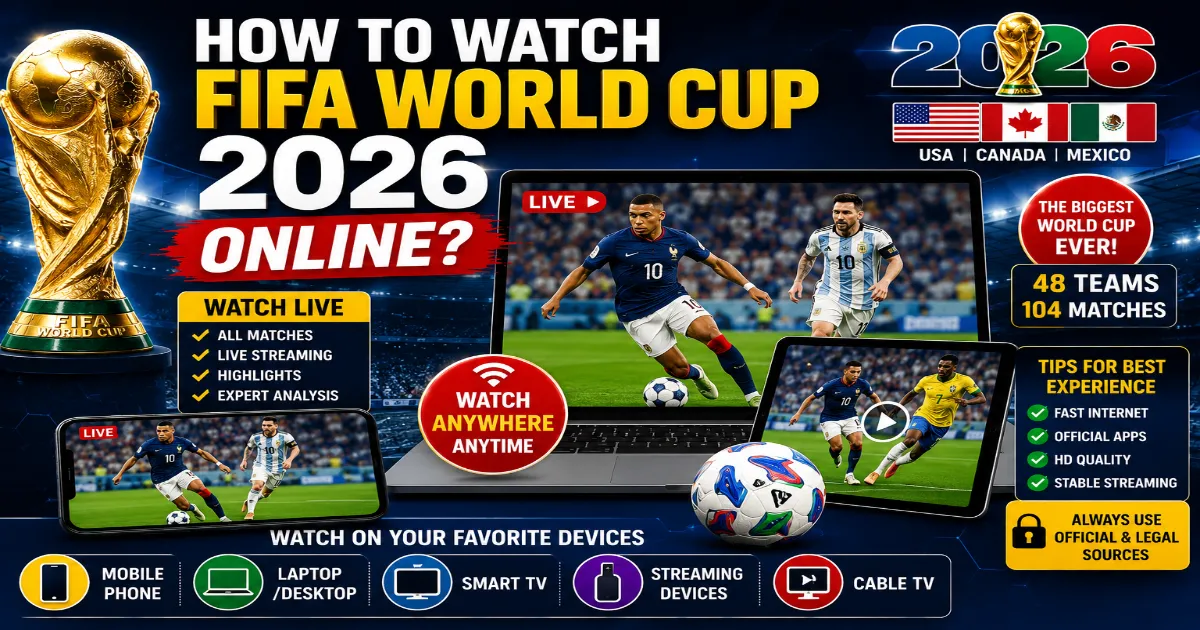
It’s finally here. The biggest football tournament in human history kicks off June 11, 2026, and finding the right way to stream it online has turned into its own competitive sport. I’ve spent the last few days digging through broadcaster announcements, pricing pages, and regional rights documents and honestly, the landscape is more fragmented than I expected. Here’s everything I found, laid out so you don’t waste a single minute when the whistle blows.
The 2026 World Cup Is Genuinely Unlike Any Before It: Here’s Why That Changes How You Watch
Most coverage glosses over just how structurally different this tournament is. I think that’s a mistake, because the format changes directly affect your streaming experience.
The 2026 FIFA World Cup is set to become the biggest football tournament in history, with 48 national teams, 104 matches, and host cities spread across the United States, Canada, and Mexico. That’s not a marketing line it’s a logistical reality. Due to the expansion of teams and the new group stage format, the 2026 World Cup will feature 104 matches in total, compared to the 64 matches played in previous editions. That’s 40 extra games 40 more chances to miss something if your streaming setup isn’t right from day one.
And consider the scale: the 2022 tournament reached over 5 billion people globally across all media, and the final match between Argentina and France had more than 1.5 billion viewers. This edition will almost certainly exceed that. Which matters. A lot.
Here’s the counterintuitive thing nobody really spells out: more matches means more simultaneous kickoffs. The expanded 48-team format includes 72 group stage matches, from the round of 32 to the final, totaling 104 matches this creates more simultaneous broadcast windows and a more complex web of broadcast rights than any previous edition. So your streaming platform must handle Multiview or concurrent streams, or you will miss games.
The 2026 FIFA World Cup Final is set to take place at the New York New Jersey Stadium (MetLife Stadium) on 19 July. That gives you roughly five weeks of live football. Before you do anything else, check whether your current streaming service carries every relevant channel for your region not just the opener.
US Viewers: FOX One vs. YouTube TV Vs. Fubo: Which Streaming Option Actually Wins?
Personally, I’d go with Fubo over FOX One for most cord-cutters primarily because it bundles everything into one interface without you hunting across apps. But let me lay out the full picture first.
FOX Sports holds the English rights and Telemundo holds the Spanish rights, together sharing all 104 matches across linear TV and streaming. A record 40 matches air in primetime FOX takes 21 of them and FS1 takes 19. That’s the baseline. Every other streaming service is just a delivery vehicle for those two channels.
The newly launched FOX One streaming app will carry all 104 matches live, with select games available in 4K. Subscriptions are $19.99/month or $199.99/year. That’s straightforward. Fubo carries FOX, FS1, and FS2 covering all 104 World Cup matches in English, with no add-on needed. Cheapest plans start from just $45.99 per month.
What about YouTube TV? YouTube TV gets you all the channels you need to watch the 2026 World Cup, including Fox, FS1, Universo and Telemundo right now available at $67.99/month for your first five months, then $82.99/month thereafter. Sure, perfectly consistent on paper. But YouTube TV livestreams tend to run a slight delay, which isn’t ideal if you’re trying to keep up with the live game down to the exact second. That delay alone would drive me crazy during a penalty shootout.
For Spanish-language fans: for $11/month, an ad-supported Peacock subscription lets you stream live sports and events airing on NBC, including Spanish-language broadcasts of every 2026 World Cup game.
Here’s a quick comparison before you commit:
| Platform | Language | Matches | Price/Month | Free Trial |
|---|---|---|---|---|
| FOX One | English | All 104 | $19.99 | 7 days |
| Fubo | English | All 104 | From $45.99 | 5 days |
| YouTube TV | English + Spanish | All 104 | $67.99 (intro) | 21 days |
| Peacock | Spanish only | All 104 | $11.00 | Via Walmart+ |
| DirecTV Choice | English + Spanish | All 104 | $104.98 (intro) | 5 days |
If you want to trial your way through the group stage completely free, YouTube TV offers a 21-day free trial the longest of any platform carrying World Cup coverage. Start there. It takes less than 5 minutes to sign up, and you can cancel anytime before day 21 without paying a cent.
How To Watch FIFA World Cup 2026 Online For Free: Legally
Look, most guides bury the free options at the bottom. I disagree with that approach entirely, because there are genuinely solid zero-cost routes that millions of viewers will miss.
First, the surprise find: Tubi, the free ad-supported streaming platform owned by Fox Corporation, will stream two marquee matches free in 4K with no subscription required Mexico vs South Africa on June 11 and USA vs Paraguay on June 12. Two of the most-watched opener fixtures, completely free. Strange, right? Most people don’t even know Tubi carries sports.
Then there’s the antenna option. An antenna will get you access to FOX stations for free. If FOX has a local affiliate in your city and in most major US metros it does you’re watching in full broadcast quality, no subscription required. I’m genuinely not sure enough people know this still works in 2026.
Globally, the UK situation is remarkable. Football fans in the United Kingdom can watch every match of the FIFA World Cup 2026 free of charge BBC and ITV share the broadcast rights, splitting coverage across the group stage, knockout rounds, and the final. All BBC matches will stream simultaneously on BBC iPlayer, while ITV’s allocation will be available on ITVX. That’s the entire tournament, fully free, legally streamed.
And the YouTube situation is actually bigger than most realize. FIFA made a “preferred platform” deal with YouTube in March 2026, allowing broadcasters to stream select games in full on their respective YouTube channels, as well as stream the first 10 minutes of every game on the platform. YouTube also extended this deal with CazéTV to show all tournament games for free in Brazil. That’s remarkable access for Brazilian fans no paywall, full tournament.
Before you pay for anything, check whether your local broadcaster streams free on YouTube. Some do. It takes 5 minutes to verify and could save you a month’s subscription fee.
International Streaming Rights: What Works Where (And What’s Still Broken)
This is where the 2026 broadcasting story gets genuinely messy, and most coverage skips over it.
In many territories, one company buys the rights and then sub-licenses matches to free-to-air channels, pay-TV networks, or digital platforms that is why a match can appear on a main channel while also streaming in an official app. Sounds fine in theory. In practice, it means you might assume you’re covered when you’re not.
Let me run through the confirmed major markets:
| Region/Country | TV Broadcaster(s) | Streaming Platform | Free Access? |
|---|---|---|---|
| USA (English) | FOX / FS1 | FOX One, Fubo, YouTube TV | Partial (Tubi) |
| USA (Spanish) | Telemundo / Universo | Peacock | Via Walmart+ |
| Canada | CTV / TSN / RDS | TSN+, RDS Direct | Partial (CTV) |
| United Kingdom | BBC / ITV | BBC iPlayer / ITVX | Yes, all 104 |
| Germany | ARD / ZDF / MagentaTV | ARD Mediathek | Partial |
| Brazil | Globo / CazéTV | YouTube (CazéTV) | Yes, all 104 |
| India | TBC | TBC | Unresolved |
That India row is not a typo. As of May 2026, no Indian broadcaster has secured rights to the tournament an extraordinary situation for one of the world’s largest and fastest-growing football markets. FIFA launched its India media rights tender in mid-2025, bundling the 2026 and 2030 World Cups together and initially seeking approximately $100 million for the package. JioStar reportedly offered $20 million, and FIFA rejected the bid outright.
No FIFA-licensed broadcaster has been confirmed for India, Bangladesh, Bhutan, Pakistan, or Sri Lanka as of May 2026. That’s a staggering combined population sitting in limbo weeks before kickoff. Actually, let me rephrase that it’s not just a rights dispute. It’s hundreds of millions of football fans potentially locked out of the planet’s biggest sporting event.
If your country is in that unresolved category, bookmark FIFA’s official Media Partners page and check it every few days. A deal could drop at any moment and you’ll want your streaming app downloaded and tested before the opener.
TikTok, YouTube, and the New Digital Layer Nobody’s Talking About
When I compared the 2022 and 2026 digital distribution strategies, the difference was enormous far bigger than most pre-tournament coverage acknowledges.
On January 8, 2026, FIFA signed a deal to make TikTok a “preferred platform” for World Cup video content as part of the agreement, broadcasters may stream parts of games at a dedicated hub on the TikTok app. That’s genuinely new territory for a men’s World Cup. And it doesn’t stop there.
The 2026 FIFA World Cup will be the first edition of the tournament fully integrated into FIFA’s expanded digital viewing strategy, with YouTube serving as one of the competition’s designated preferred platforms. For the first time, participating broadcasters will have the option to stream the opening 10 minutes of every World Cup match live on their official YouTube channels the initiative is aimed at increasing accessibility and engaging younger, mobile-first audiences who increasingly consume football through digital platforms.
Most articles frame this as a footnote. I disagree. It’s actually a meaningful free access point. Ten minutes of every single match, globally, on YouTube no login, no subscription. That’s 1,040 minutes of free live football across the group stage alone. Which matters if you’re budget-conscious or just want to check whether a game is worth staying up for.
FIFA+ will provide highlights, press conferences, and behind-the-scenes content throughout the tournament, but it will not carry live match coverage in territories where exclusive broadcast rights belong to a local partner which covers virtually every major market. So don’t count on FIFA+ as a fallback for full live games. It won’t be one.
Fans will be able to watch matches live through smart TVs, Apple TV, Roku, Amazon Fire TV, Android TV, gaming consoles, smartphones, tablets, and laptops.
The one thing worth doing right now: download your broadcaster’s app today, create your account, and run a test stream. Doing it on matchday guarantees login errors and buffering panic.
Device Setup, VPNs, and Avoiding Matchday Technical Disasters
Honestly? The technical side trips up more fans than the rights complexity does. I’ve seen people miss 20 minutes of a knockout match because their app hadn’t updated since 2024. Don’t be that person.
Whether you’re at home on a smart TV or following the tournament on your phone, Fubo’s apps for iOS, Android, Roku, Apple TV, Fire TV, and game consoles mean you’re never more than a tap away from kickoff. That’s the kind of device flexibility you should demand from whatever platform you choose. If your streaming service doesn’t have a native app on your TV platform, that’s a real inconvenience across 104 matches.
On the VPN question and I’m genuinely uncertain whether recommending one is useful or misleading here the data points both ways. Rights are typically exclusive within a territory. A service in one country may not legally stream matches in another country.
This is also why travel can affect your access. Fans travelling during the tournament may still be able to access their usual streaming services, although availability will depend on regional broadcasting agreements. Some platforms include travel-friendly access options, while others may restrict content outside specific countries. Checking your broadcaster’s international streaming policies before travelling can help avoid interruptions during the tournament.
A simple rule I follow: test your full streaming setup device, login, and a live broadcast at least 48 hours before a match you actually care about. It takes 10 minutes and saves a full-blown technical meltdown when your national team is on the pitch.
And one more thing worth knowing for the travelers among you Sport24 holds rights for international in-flight and cruise ship broadcasts, covering more than 600 aircraft and 100 cruise ships worldwide airlines that carry it include Emirates, Turkish Airlines, and Singapore Airlines, while Royal Caribbean and Carnival cruise lines also carry the channel. So even mid-flight, you might catch a match. Which is a genuinely lovely detail.
Final Thoughts
The single clearest takeaway from all of this research your access to the 2026 World Cup depends almost entirely on where you live and which platform you verify before June 11 not after. The options are abundant, but the fragmentation is real, and assuming you’re covered without checking is how fans miss historic moments.
Personally, I’d start with the longest free trial available in your region, test the app on your actual device today, and upgrade only if the experience holds up. The tournament runs until July 19 set yourself up right once, and then just enjoy the football.
Related Articles
Updated FIFA World Cup 2026 Power Rankings
Ten days. That’s all that stands between us and the opening whistle of the biggest football tournament ever…
Supercomputer Predicts FIFA World Cup 2026 Winner
When I first saw the numbers, my gut reaction was mild skepticism. Spain, again? But the figures are…