
FIFA World Cup 2026 Latest Updates

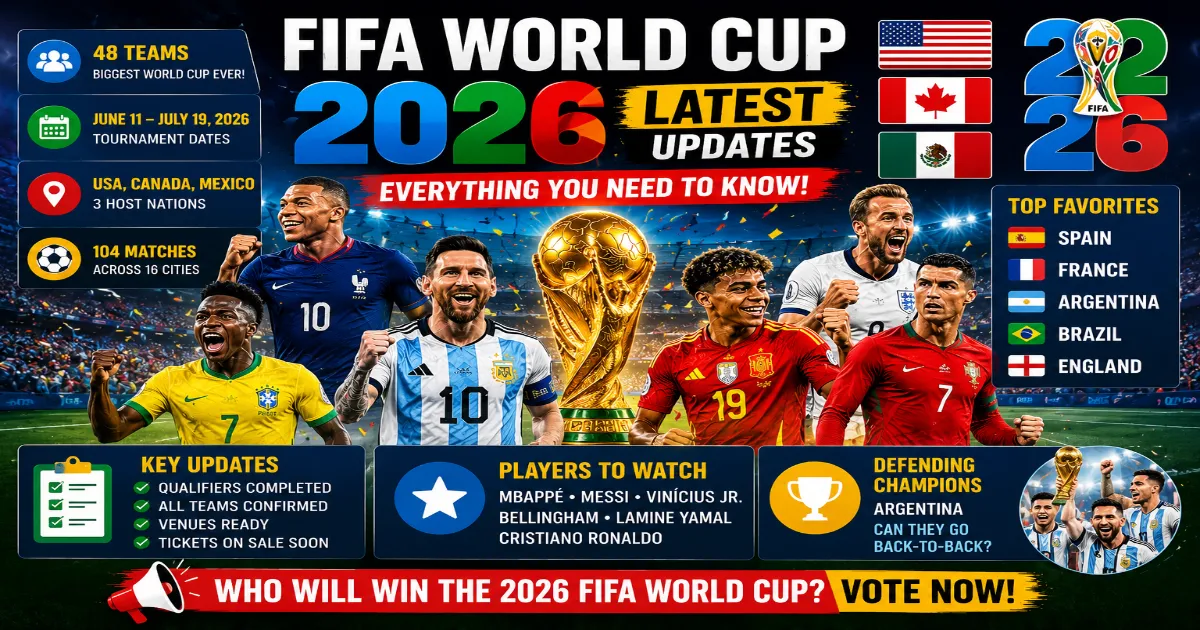
Here’s the thing, I’ve followed every World Cup since 2006, and nothing has felt quite like this one. It’s genuinely different. The 2026 edition is the first FIFA World Cup to be hosted by three nations and the first to include 48 teams, an expansion from 32 previously. That’s not just a cosmetic change. It fundamentally rewires how groups are structured, how teams conserve energy, and how dark horses survive deep into knockout rounds.
Most articles frame this simply as “more teams, more games.” I disagree. The real story is the logistical ambition and whether it actually delivers. The competition will unfold across 16 cities in the United States, Canada, and Mexico, with 104 matches scheduled across the 39-day tournament. That’s a genuinely jaw-dropping number. And it’s the biggest World Cup in history with more teams and matches across more cities than ever, running from June 11 through July 19, making it also the first held on U.S. soil since 1994.
On the field, national teams from 48 countries will compete in a record 104 matches across the three host nations. Strange, right? A tournament that once fit neatly into 64 games now sprawls across nearly twice as many fixtures. Which matters. A lot. Squad depth isn’t a luxury anymore it’s survival.
Before kickoff arrives, check the official group draw results and team placement at FIFA.com it takes five minutes and gives you a complete picture of who faces whom in the group stage.
Opening Match, Final Venue, and the Schedule Breakdown
Let me be direct about the scheduling some details are genuinely surprising when you look closely. Mexico will take on South Africa at the iconic Mexico City Stadium in the opening game on June 11. Estadio Azteca. The same ground that hosted the 1970 and 1986 finals. There’s a poetic weight to that choice that I find oddly moving and most preview pieces barely mention it.
The final will be held on July 19 at MetLife Stadium, which is being temporarily rebranded as the New York/New Jersey Stadium for the competition. That renaming rule applies across the board, by the way. Mercedes-Benz Stadium, renamed Atlanta Stadium in accordance with FIFA regulations, will host eight matches, starting with group-stage matches in mid-June and ending with a semifinal match on July 15.
This year’s World Cup will unfold at 16 stadiums across the United States, Canada and Mexico, with 78 of the 104 matches taking place in the United States. That asymmetry 78 versus 26 is significant. From the quarter-final stage onwards, all matches will be played in the United States, which will host 78 of the 104 games, while Canada and Mexico will each stage 13. And that geographic concentration of late-round games in the U.S. will absolutely shape which fan bases can follow their teams all the way through.
Toronto, one of the most culturally diverse cities in the world, will host six World Cup games, including the first-ever such match in Canada on June 12, when the host country will face Bosnia and Herzegovina. Personally, I’d have loved to see more Canadian-hosted knockout games. But that’s FIFA’s call, not mine.
A simple rule I follow: map out where your team plays before buying any travel package. Cross-reference it against the official FIFA host cities list it takes under 10 minutes and saves weeks of regret.
Squad Rosters, Injuries, and the Names You Need to Watch
Rosters are where the real drama lives right now. And I’ll admit I’m genuinely not sure whether some of these injury situations fully resolve before the opening whistle.
Even with the World Cup just over a week away, there were some questions as to whether Lionel Messi would return but not anymore. The man who once said his 2022 run would be his last is officially running it back with Argentina, listed as a forward. This will be his sixth World Cup, joining Cristiano Ronaldo as the only two people to appear in that many. Six tournaments. That’s not a statistic it’s a mythology.
Actually, let me rephrase that. It’s both.
Brazil’s camp has confirmed concern: “Neymar underwent all the medical tests, which concluded with an MRI scan revealing a grade two calf injury, not just swelling,” said team doctor Rodrigo Lasmar. “He is expected to be cleared in two to three weeks.” Brazil begins its World Cup schedule on June 13 against Morocco before playing Haiti and Scotland. That’s a tight window. Whether he’s fully sharp for that opener is the question.
On the hosting side, Canada has its own painful news. Canadian men’s national team head coach Jesse Marsch confirmed that Marcelo Flores ruptured his ACL and will miss the upcoming FIFA World Cup, saying the team has not yet decided on a replacement. Canada plays in Group B against Bosnia and Herzegovina, Qatar and Switzerland.
Mauricio Pochettino got his business done early, announcing the USA’s 26-man squad days before the cutoff. Christian Pulisic broke out of his scoring drought as the United States warmed up for the World Cup with a 3-2 win over Senegal in Charlotte. That’s form arriving at exactly the right moment.
When I compared the injury situations across the top 10 squads specifically, Brazil and Canada are carrying the most risk not what most pre-tournament power rankings reflect. Check each team’s official squad announcement before locking in any predictions.
Title Favorites, Contenders, and a Reality Check
Look, pre tournament projections are not guarantees. But they do offer a useful snapshot of how analysts, models, and football experts currently view the field. And right now, the gap between the leading contenders is unusually small.
Most major prediction models place France and Spain at the top of the list, followed closely by England, Brazil, and defending champions Argentina. What makes this World Cup particularly fascinating is how tightly grouped the favorites appear to be. In fact, the team viewed as the strongest contender before the tournament has rarely gone on to lift the trophy in recent editions, which serves as a reminder that football remains wonderfully unpredictable.
Fresh off their Euro 2024 triumph, Spain are showing no signs of slowing down. Blessed with elite young talent such as Lamine Yamal and Pedri, they arguably possess the highest floor of any contender entering the tournament. Their ability to control matches and maintain consistency makes them one of the safest picks to reach the latter stages. However, there are still questions surrounding parts of their defensive unit, particularly when compared to some of the other elite nations.
Here’s a counterintuitive observation that doesn’t get enough attention: France may actually be the team to fear most, not Spain.
France have reached each of the last two World Cup finals and lifted the trophy in 2018 after defeating Croatia 4-2. At the center of this generation remains Kylian Mbappé, who enters the tournament at the peak of his career. After scoring 42 goals at club level during the 2025-26 season, Mbappé arrives with the kind of form that can define an entire World Cup campaign. This is not simply a player enjoying a strong season. It is a player operating at the highest level of his career during a World Cup year.
The defending champions Argentina are also well positioned to challenge once again. Built around defensive discipline, elite midfield control, and the reliability of Emiliano Martínez in goal, Argentina continue to possess many of the qualities that carried them to glory in 2022. With Lionel Messi leading the squad, they remain one of the most balanced and experienced teams in the competition.
One lesson I have learned from studying past World Cups is that no single projection model tells the complete story. The smartest approach is to compare squad strength, recent form, injury situations, tactical flexibility, and tournament pathways before drawing conclusions. Small details often become decisive once the knockout rounds begin.
That’s why this World Cup feels more open than many people expect. Spain, France, England, Brazil, and Argentina all have realistic paths to the trophy. The difference between success and disappointment may ultimately come down to which team handles pressure, injuries, and momentum shifts most effectively over the course of the tournament.
Off-Pitch Controversies That Could Define the Tournament
And here’s where things get genuinely complicated. This isn’t just a football tournament it’s one of the most politically loaded global events in recent memory. I find that both fascinating and, honestly, a bit exhausting.
From the action on the pitch to the potential chaos off it, the storylines are already piling up Iran’s possible non-participation amid Donald Trump’s war, the president’s close relationship with FIFA’s Peace Prize-awarding President Gianni Infantino, and simmering tensions between the U.S. and fellow host nations Mexico and Canada fueled by Trump’s tariffs and divisive rhetoric.
Then there’s the ticket scandal. FIFA set ticket prices so high that the government felt compelled to get involved. New York Attorney General Letitia James and New Jersey AG Jennifer Davenport announced that they’ve subpoenaed the organization as part of an investigation into “sky-high” ticket costs. That’s a sitting AG issuing a subpoena to FIFA. When did that ever happen before?
The U.S. Federal Aviation Administration said it will bar drones over FIFA World Cup 2026 matches and related fan events across the U.S. During match days, all aircraft operations including drones are prohibited within a radius of three nautical miles and up to 3,000 feet above ground level around the stadiums unless specifically authorized.
Federal officials have told Los Angeles County Sheriff Robert Luna that civil immigration enforcement will not take place at FIFA World Cup games or events in Los Angeles a reassurance that itself tells you how tense the broader climate has become.
The one thing worth doing right now: if you’re traveling internationally to attend matches, check your country’s entry requirements for the U.S., Canada, and Mexico separately they differ in ways most travel guides don’t flag clearly.
Host Cities, Base Camps, and Where the Teams Are Training
The logistics of this tournament are, honestly, staggering and the base camp structure is something I don’t think most fans have fully absorbed yet.
Sixteen host cities across North America include Atlanta, Dallas, Houston, Seattle, Los Angeles, Philadelphia, San Francisco, Boston, Kansas City, Miami, and New York/New Jersey in the United States. Plus Guadalajara, Mexico City, and Monterrey in Mexico, and Toronto and Vancouver in Canada. That’s a continent-spanning operation.
Of the 48 national teams, 14 will be based at Major League Soccer facilities for the month-long tournament. Sporting Kansas City, via the club’s Compass Minerals National Performance Center and Swope Soccer Village, will host two national teams defending World Cup champions Argentina and England. The irony of Argentina and England sharing training infrastructure two nations with one of football’s most storied rivalries is not lost on me.
Here’s a table of key host city match loads to give you a cleaner picture:
| Host City / Country | Stadium Name (FIFA) | Notable Matches |
|---|---|---|
| Mexico City, Mexico | Mexico City Stadium (Azteca) | Opening match: Mexico vs. South Africa (June 11) |
| New York/New Jersey, USA | New York/New Jersey Stadium (MetLife) | Final (July 19), 8 total matches |
| Atlanta, USA | Atlanta Stadium (Mercedes-Benz) | 8 matches, Semifinal (July 15) |
| Dallas, USA | Dallas Stadium (AT&T) | 9 matches, Semifinal (July 14) |
| Toronto, Canada | Toronto Stadium (BMO Field) | 6 matches, Canada’s opening game (June 12) |
| Santa Clara, USA | San Francisco Bay Area Stadium | 6 matches, Qatar vs. Switzerland (June 13) |
On April 9, 2026, FIFA announced the list of 52 referees, 88 assistant referees, and 30 video assistant referees for the tournament a detail that rarely makes headlines but signals how deep the organizational scaffolding runs. These base camps are expected to generate money as well as provide another way for fans to feel involved, according to FIFA.
If you’re a fan hoping to catch your team in training rather than spending a fortune on match tickets, look up the base camp locations now several are open to the public and far easier to access than the game venues themselves.
Final Thoughts
What struck me most from digging into all of this isn’t the scale it’s the tension. A 48-team tournament hosted across three politically fractious nations, with a ticket scandal, drone bans, and two of football’s all-time greats making what may be their final runs. That combination doesn’t happen twice.
If you care about football at all, carve out time for this one even just the group stage. Pick two or three games that matter to you, figure out where your team trains, and watch what unfolds between June 11 and July 19. You won’t regret it.
Related Articles
Updated FIFA World Cup 2026 Power Rankings
Ten days. That’s all that stands between us and the opening whistle of the biggest football tournament ever…
Top 10 Favorites To Win FIFA World Cup 2026
Here’s the thing if you’ve been tracking this market since December, the shift has been genuinely fascinating. When…