
Teams Participating In The 2026 FIFA World Cup

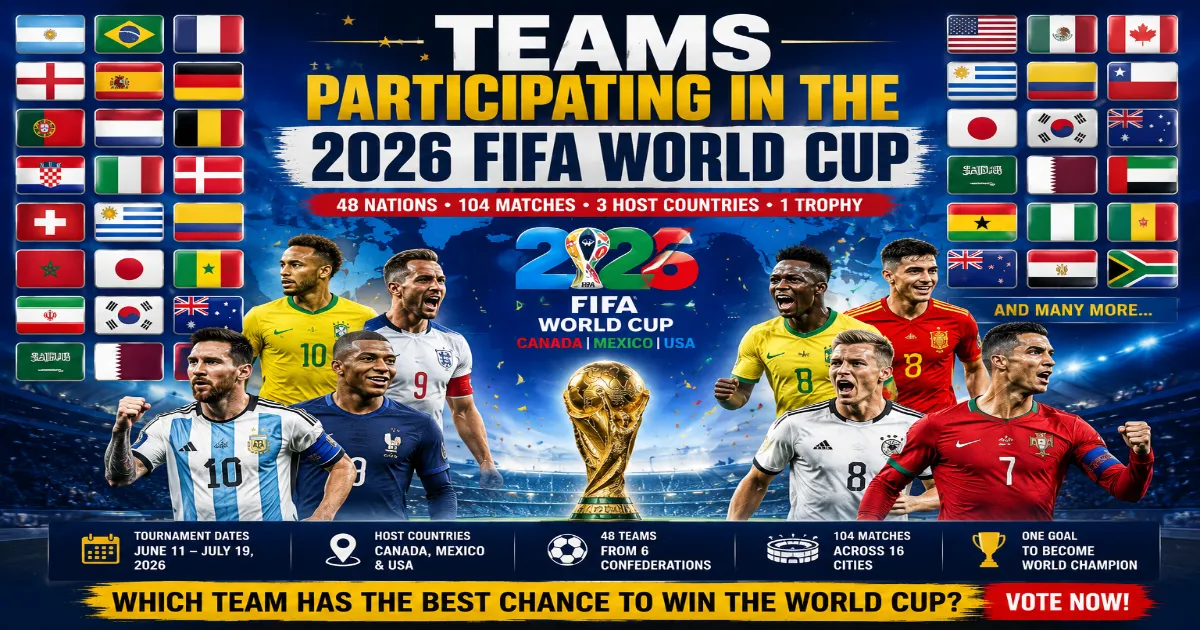
Nine days. That’s all that stands between us and the loudest sporting event on the planet. The 2026 FIFA World Cup kicks off June 11, and honestly, I’ve been tracking this tournament since qualification began. The closer it gets, the harder it is to sleep. What started as a casual interest turned into a deep-dive obsession squads, group draws, debut nations, historical patterns. And what I found surprised me more than once.
The Historic 48-Team Expansion and What It Actually Changes
Here’s the thing most coverage leads with “48 teams!” as if it’s just a bigger number. But when you sit with the actual structural consequences, it’s genuinely transformative. The tournament is the first FIFA World Cup to be hosted by three nations, and the first to include 48 teams, an expansion from 32 previously. That’s not incremental. That’s a paradigm shift.
The teams will be split into twelve groups of four, with the top two in each group and the eight best third-placed teams progressing to a new round of 32 the first expansion and format change since 1998. Most articles frame this as “more football.” I’d push back on that framing. What it really means is more pathways to survive. A third-place finish no longer kills you outright, which changes how coaches approach match-day three completely.
The total number of matches will increase from 64 to 104, and the tournament will last 39 days up from 32 days in 2014 and 2018. Strange, right? A week extra doesn’t sound like much until you factor in player fatigue across an already brutal season. Teams may need to play eight matches to win the tournament one more than any previous finalist has faced. That extra game could genuinely alter which squad depth wins it.
Before watching a single group-stage match, check how your favorite team has managed rotation through long seasons. Depth isn’t a luxury in this format it’s the whole game.
The Complete Confederation Breakdown: Who Made It and Who Didn’t
When I compared the 2022 allocation to this one specifically, the jump in African and Asian representation was far larger than I’d expected going in. UEFA took the largest allocation with 16 spots the most for any single confederation in World Cup history. CAF jumped from five to 10 places, AFC from four to nine, and the three host nations took automatic CONCACAF slots. That’s a doubling for Africa. Worth pausing on.
| Confederation | Teams in 2022 | Teams in 2026 | Notable Qualifiers |
|---|---|---|---|
| UEFA (Europe) | 13 | 16 | England, France, Germany, Spain, Portugal |
| CAF (Africa) | 5 | 10 | Morocco, Senegal, South Africa, DR Congo |
| AFC (Asia) | 6 | 9 | Japan, South Korea, Saudi Arabia, Jordan |
| CONMEBOL (South America) | 6 | 6 | Argentina, Brazil, Colombia, Uruguay |
| CONCACAF (N/C America) | 4 | 6 | USA, Mexico, Canada, Panama, Haiti, Curaçao |
| OFC (Oceania) | 1 | 1 | New Zealand |
The ratification of slot allocation gave the OFC a guaranteed berth for the first time the 2026 FIFA World Cup will be the first tournament in which all six confederations have at least one guaranteed berth. That detail tends to get buried. It matters.
Personally, I’d have given South America one extra slot instead of Europe’s expanded count the continental depth there is frankly underrepresented. But that’s a conversation for another cycle.
The one thing worth doing right now: check the full confederation breakdown at FIFA.com to see exactly which groups contain two European teams since the only exception to the one-confederation-per-group rule is UEFA, and because 16 European teams must fit into 12 groups, some groups contain two UEFA nations.
First-Timers, Long-Absent Nations, and the Biggest Comeback Stories
Look, this is the section most people skim. Don’t. The debut and return stories at this tournament are genuinely extraordinary.
Cabo Verde, Curaçao, Jordan, and Uzbekistan will make their tournament debut at the 2026 FIFA World Cup. Qatar is also advancing for the first time through the qualifying system, having previously debuted as the host of the 2022 edition. Four brand-new nations on football’s biggest stage. Curaçao made history as the smallest nation population 156,000 ever to reach a World Cup. That number hit me hard. That’s a mid-sized city qualifying for the World Cup.
Iraq is returning for the first time since 1986; Austria, Norway, and Scotland are participating in their first World Cup since 1998; Türkiye is making an appearance for the first time since 2002; and the Czech Republic is returning after a 20-year gap, having last played in the 2006 World Cup. And yet the counterintuitive observation nobody mentions these “returning” sides aren’t the same teams from decades past. Norway, for instance, arrives with Erling Haaland in arguably the best form of his career. France vs. Norway could be the group-stage match of the tournament. Erling Haaland vs. Kylian Mbappé is as high a billing as it gets at any World Cup.
On the flip side, Italy missed qualification for a third consecutive time and Bosnia and Herzegovina stunned Italy on penalties in the Path A final. Sure, perfectly consistent on paper, Italy are a top-12 side globally. And yet, here we are again.
A simple rule I follow: never dismiss a debut nation until you’ve looked at their qualifying stats. Cape Verde topped their group ahead of Cameroon. That’s not luck. That’s a team.
The Title Contenders And Why the Favorites Aren’t as Clear-Cut as You Think
Most previews hand you a tidy list France, Spain, England, Brazil, Argentina. Done. I disagree, and here’s why: the rankings are compressed in a way that’s historically unusual.
Based on the April 1, 2026 update, the top five are France (No. 1), Spain (No. 2), Argentina (No. 3), England (No. 4) and Portugal (No. 5). Brazil sit sixth. Less than three points separate the top three teams. When the gap between first and third is effectively noise, “favorites” becomes a marketing term more than an analytical one.
Germany needs a strong tournament after early exits in recent World Cups. When I looked at their squad specifically the blend struck me. The squad blends the youthful brilliance of Jamal Musiala and Florian Wirtz with the experience of Joshua Kimmich, Antonio Rüdiger, and veteran goalkeeper Manuel Neuer, who surprised many by coming out of international retirement for the tournament. That balance of hunger and know-how is exactly the profile that wins tournaments. Actually, let me rephrase that it’s not just balance it’s the right kind of desperation.
Argentina’s title defense: the defending champions will try to repeat after their 2022 triumph. Lionel Messi was named in Argentina’s initial roster for their title defence though nobody is quite sure what his physical ceiling looks like nine months after his last competitive run. I’m genuinely not sure whether he or Mbappé carries the bigger burden heading into the group stage the data I’ve seen points both ways.
Before you lock in a bracket prediction, cross-check your pick against the knockout pathway Spain and Argentina have been placed in opposite pathways, meaning a final between them is entirely possible. Start there. It takes ten minutes and saves hours of post-group-stage confusion.
The Host Nations: Pressure, Advantage, and the Stakes for USA, Mexico, and Canada
Hosting a World Cup is the strangest double-edged gift in sport. The crowd lifts you. The expectation crushes you. All three co-hosts know this feeling is coming.
The United States hosts its first men’s World Cup since 1994 and enters with one of its most globally experienced player pools. Home matches and deep squad familiarity could help the USMNT compete beyond the group stage. That 1994 comparison is instructive the US reached the round of 16 as hosts back then. The current roster is significantly more technically capable though the expectations have also grown proportionally.
Mexico opens the tournament at Estadio Azteca and becomes central to one of the most historic World Cup hosting moments. El Tri will rely on home support, tournament experience, and the pressure of playing in front of one of football’s most passionate fan bases. With its past hosting of the 1970 and 1986 tournaments, Mexico will become the first country to host or co-host the men’s World Cup three times. That’s an incredible legacy to carry into match day one.
Canada is the quietest of the three hosts yet arguably the most interesting. Canada plays all three group matches on home soil, starting in Toronto. They qualified for their first World Cup since 1986 in 2022 and arrive now with a more settled, experienced group.
The surprising thing that nobody really mentions: home advantage for Canada may be more significant than for the US, simply because Canadian fans will treat every match like a cup final.
This edition’s total distribution for the tournament will be $871 million $431 million higher than the prize pool of the previous tournament. In addition, each qualified team will also receive a $10 million qualification payment and a $2.5 million preparation fee. That’s the financial weight sitting behind every kick-off. Watch the host nations’ opening matches emotional intensity in those games tells you more than any friendly result.
The Off-Field Tensions: Iran, Politics, and What They Mean for the 48-Team Field
Anybody who covers just the football is missing half the story at this tournament.
- Bottom line: geopolitics has never pressed this hard against a World Cup field this large.
Several reports suggest that the 2026 edition is taking place in a more complex context, with political tensions including those involving Iran and the United States as well as security concerns and immigration and visa policies in the United States, potentially making participation more difficult. That’s a diplomatic way of describing a genuinely fraught situation.
On May 10, 2026, Iran announced its demands for attending the World Cup, which include visa guarantees for players, staff, journalists, and fans without further questioning by immigration authorities, security guarantees for players and staff, and “respectful” treatment of the Iranian flag and symbols. I’ll be honest I found myself reading that list and feeling a kind of frustration that’s hard to articulate. These are athletes. They just want to play football. The politics surrounding their participation has nothing to do with sport.
Russia were suspended indefinitely on 28 February 2022 from participating in UEFA and FIFA competitions for the country’s invasion of Ukraine making their absence from the 48-team field a reminder that this tournament, like all, reflects the world it sits inside. And this was the first time that eight Arab nations Algeria, Egypt, Iraq, Jordan, Morocco, Qatar, Saudi Arabia, and Tunisia qualified for the World Cup, an increase from four teams in 2018 and 2022. Which matters. A lot. The Arab world’s expanded footprint at this tournament is both a sporting achievement and a cultural moment.
Before you tune in for the opening ceremony on June 11, spend five minutes reading about Iran’s qualification saga. Context makes football mean more not less.
Final Thoughts
What the data from the last few weeks confirms is this the 2026 World Cup isn’t just bigger it’s structurally different in ways that will produce genuinely unpredictable results, especially with four debut nations, a dozen returning sides, and the tightest top-three rankings gap in recent memory.
Personally, the story I’ll be watching most closely isn’t a superstar it’s whether a first-time qualifier like Curaçao or Jordan can stun a European giant before the group stage ends. If you’re new to following the tournament, pick one underdog from the debut nations and follow them match by match. You won’t regret it.
Related Articles
Who Will Win The 2026 FIFA World Cup? My Analysis And Prediction
Here’s the thing most people are treating this tournament like every other World Cup. They’re not. For the…
How The FIFA World Cup Player Of The Tournament Is Selected
Most fans watch the entire FIFA World Cup, cheer their lungs out, then look up at the end…