
Top 10 Favorites To Win FIFA World Cup 2026

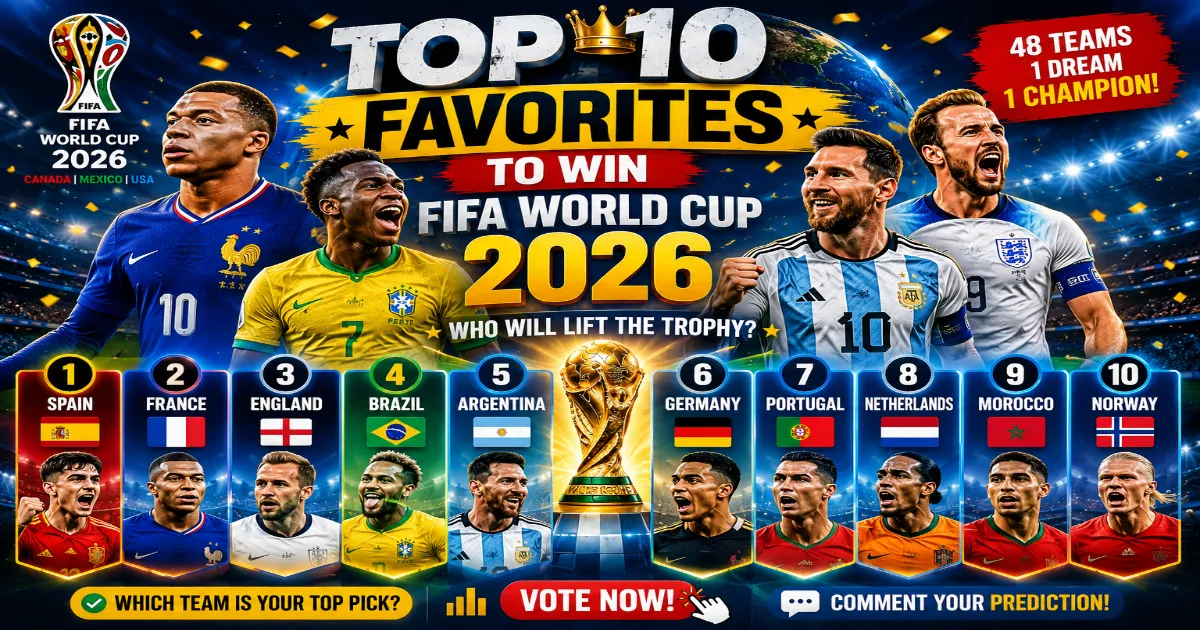
Here’s the thing if you’ve been tracking this market since December, the shift has been genuinely fascinating. When the World Cup groups were announced, Spain opened as the favorite at +450, followed by England at +550 and France at +750. Fast forward to today, and the picture looks quite different. Spain has slightly drifted to +475, while both France and England have made up considerable ground on the oddsboard. That drift matters. It’s the market whispering something most articles flat-out ignore.
Personally, I find the France surge the most compelling storyline here. Spain (+488) sit just ahead of France (+499) and England (+801) as the current favorites to win the 2026 FIFA World Cup a gap so thin it’s essentially a coin flip between the top two. Strange, right? Spain and France have swapped places atop the market once again, with England being the only other team with a 10% or greater win probability.
Below is the full picture of where the top 10 contenders stand across multiple sportsbooks as of early June 2026:
| Rank | Team | Expert Ranking | AI Win Probability |
|---|---|---|---|
| 1 | Spain | No. 1 Favorite | 16.08% |
| 2 | France | Strong Contender | 12.78% |
| 3 | England | Major Contender | 11.01% |
| 4 | Argentina | Defending Champion | 10.02% |
| 5 | Portugal | Strong Challenger | 6.84% |
| 6 | Brazil | Elite Contender | 6.48% |
| 7 | Germany | Rising Threat | 5.66% |
| 8 | Netherlands | Dark Horse | N/A |
| 9 | Norway | Emerging Contender | ~3% |
| 10 | Belgium | Outside Challenger | 2.34% |
Before you anchor to any single sportsbook number, cross-reference at least two books the gap between platforms on teams like Portugal and Argentina is wider than most fans realize, and it saves real money.
Spain and France: Why the Two-Horse Race at the Top Is More Complicated Than It Looks
Most articles crown Spain and call it a day. I disagree, and here’s why: the gap between these two sides is genuinely closer to zero than any odds line admits. Spain tops Opta’s AI ranking with a 16.08% probability, driven by an extraordinary generation featuring talents like Lamine Yamal, Pedri, and Rodri. They arrive as reigning European champions and recent UEFA Nations League finalists. That résumé is hard to argue with.
Yet here’s something that nobody really mentions: a hamstring question mark hangs over that résumé. Spain remain the collective favorites to win, but voters have distributed their first-place votes more equitably considering the significant hamstring injury suffered by teenage winger Lamine Yamal. Lose him early, and this whole conversation reshapes overnight. Which matters. A lot.
France, on the other side, carries its own weight. They have the squad to win the tournament and the history to back it up two World Cup titles, a final appearance in 2022, and a core that still revolves around Kylian Mbappé at his peak. At 26, Mbappé is just five goals away from surpassing Miroslav Klose’s record of 16 career World Cup goals. That chase alone gives him a motivational edge few opponents can match.
The surprising thing about France that nobody mentions: their group is legitimately difficult. Manager Didier Deschamps’ final World Cup campaign faces some creeping concerns, as they don’t have an easy group in which to gain much-needed early form. If Les Bleus stumble in the group stage, the odds shift fast. Personally, I’d lean Spain over France primarily because their structural depth doesn’t hinge on one injury-prone superstar’s fitness.
A simple rule worth applying: when two teams sit within 25 points of each other on the odds board, treat them as equals and look at squad depth instead of market position alone.
Argentina, England, and Brazil: The Trio Fighting for the Third Spot on Every Pundit’s Ballot
Honestly? The middle tier of this market is where the real drama lives. Everybody fixates on the top two. Meanwhile, three heavyweight nations are quietly building compelling cases of their own.
The defending champions are well-equipped to defend their title, even if Lionel Messi takes on a reduced role in 2026. Argentina remain one of the most balanced teams in the tournament, built around a strong defensive structure, elite midfield control, and one of the steadiest goalkeepers in the world in Emiliano Martínez. They’ve lost just once since the beginning of 2025 and are brimming with belief.
Sure, perfectly consistent on paper. But no nation has retained the World Cup since Argentina’s fierce rivals Brazil in 1962, which is a historical wall that looms over every defending champion.
England is the team I genuinely can’t figure out. The Three Lions are considered leading contenders for the title 60 years on from their only triumph but uninspiring performances during a draw with Uruguay and a defeat to Japan have left real doubts about Thomas Tuchel’s pragmatic approach.
A team with Jude Bellingham, Cole Palmer, Bukayo Saka, and Harry Kane should not be playing drab soccer. Yet somehow they are. I’m genuinely not sure whether England’s talent ceiling or their tactical ceiling matters more here the data points both ways.
Brazil under Carlo Ancelotti represents something fresh. More structured, more defensively organized than recent cycles, with Vinicius Júnior and Raphinha still offering elite attacking quality on both wings. It feels like an eternity since they last lifted the trophy in 2002, and the pressure surrounding this squad only continues to grow. Before you write them off, check their attacking metrics against top-10-ranked opposition they’re scarier than their odds suggest.
Portugal, Germany, and the Netherlands Legitimate Contenders or Wishful Thinking?
Look, this section is where most articles get sloppy lumping these three together as “dark horses” and moving on. That’s lazy. Each has a completely distinct profile worth understanding separately.
Portugal arrives with a fascinating identity crisis. Likely preparing for the final World Cup of Cristiano Ronaldo’s legendary career, the Portuguese arrive as reigning UEFA Nations League champions, and Opta gives them a 6.84% chance of lifting the trophy. Bruno Fernandes and João Félix lead a strong squad, and manager Roberto Martínez has brought genuine tactical stability. At +900, they represent arguably the best value in the top seven.
Germany is the one that confuses me most. The four-time world champions used to enter every tournament among the absolute favorites, but their decline since winning in 2014 means expectations have been justifiably tempered, and their influence has undeniably waned. Florian Wirtz and Jamal Musiala carry the bulk of the creative burden, while Joshua Kimmich and Antonio Rüdiger are expected to lead defensively. When I compared Germany’s recent results against top-10 opponents versus Spain’s, the gap was striking not what most expect given Germany’s brand reputation.
The Netherlands? This is not a vintage Dutch squad. Several of their stars are limping through the end of their club campaigns, making a long run seem less likely. Still, Netherlands at 20/1 may look underrated Ronald Koeman has built a solid side around Virgil van Dijk and Ryan Gravenberch, with several key players arriving with strong European club form. The one thing worth doing right now: bookmark their group-stage draw and check whether they avoid Spain and France until the semifinals.
Norway and Belgium: The Dark Horses That Actually Have a Statistical Case
Here’s the thing most prediction pieces skip entirely: Norway qualifying for this tournament is genuinely seismic. Despite reaching their first World Cup this century, Norway has already entered the conversation as the competition’s dark horse chiefly because Erling Haaland can single-handedly fire the Scandinavians deep into the tournament, aided by a perfect qualification campaign that included two thumping wins over Italy. Two wins over Italy in qualification. Let that sink in for a second.
Alongside Haaland, stars such as Martin Ødegaard, Alexander Sørloth, and Julian Ryerson give Norway a squad with genuine knockout-stage quality. The counterintuitive observation nobody is making loudly enough: in a 48-team expanded tournament, a nation only needs to peak for five or six matches. Norway’s style direct, physical, devastatingly efficient is built precisely for that format.
Belgium closes out the top 10. Opta gives them just a 2.34% probability of winning the title. Even so, remaining among the favorites reflects the respect still generated by their talented golden generation. Frankly, that generation is aging out fast, and I’d be cautious about backing them at any price shorter than +4000. The squad depth behind the stars has genuinely thinned.
Actually, let me rephrase that. Belgium no longer belongs in the top tier of World Cup favorites. They’re the kind of team that could quietly reach the quarterfinals without surprising anyone, but it’s difficult to view them as a genuine title contender. Understanding that distinction is important when evaluating the tournament’s strongest teams.
If you’re tracking the dark horse market right now, spend five minutes comparing Norway’s knockout-stage path versus Belgium’s group draw. The difference in difficulty is significant and that single factor could define who advances furthest between them.
The Expanded 48-Team Format and How It Quietly Reshapes Every Favorite’s Actual Path to Glory
This is the angle I wish more analysts were discussing. The 2026 FIFA World Cup will be the biggest ever, with the tournament expanding from 32 to 48 teams. Most coverage treats that as a footnote. It isn’t. It fundamentally alters how favorites navigate the competition and not always in the way you’d expect.
The tournament begins on June 11 and concludes on July 19 at MetLife Stadium, where the next world champion will be crowned. That’s a longer calendar, more matches, and more accumulated fatigue for the biggest squads. Teams like Spain and France who rotate heavily and rely on physical pressing face a genuine attrition risk that didn’t exist in a 32-team structure.
There’s a flip side, though. Host nations often benefit from automatic qualification, regional familiarity, and strong fan support, but that does not automatically make them top title contenders. The United States, Mexico, and Canada are generally viewed as competitive teams capable of causing problems for stronger opponents, yet most analysts still place them below the tournament’s elite nations. Home advantage certainly helps, but overall squad quality remains the biggest factor in determining how far a team can realistically go.
The United States is a good example. Playing in front of large home crowds could provide a significant boost, but expectations remain measured because of the gap that still exists between their squad and the tournament’s strongest teams.
One thing that stood out to me when comparing group difficulty among the leading contenders is how much uncertainty the expanded 48 team format introduces. Team strength, recent form, qualifying performances, and projected knockout paths all remain important factors. However, the larger tournament structure creates far more variation than the previous 32 team format ever did.
A single upset in the Round of 32 could dramatically reshape an entire side of the bracket. That’s why predicting this World Cup feels more challenging than many previous editions. The favorites are still the favorites, but the path to the trophy may be far less predictable than it appears on paper.
A simple rule I follow: in any expanded tournament, trust depth over peak quality. Spain has both. Brazil has peak quality but question marks over depth given injuries. That gap roughly 12 positions on the odds board between them feels about right, actually.
Before finalizing any prediction, map each favorite’s projected route from the Round of 32 through to the final. It takes about 10 minutes using the bracket and repays hours of guesswork about which team has the “easier” path.
Final Thoughts
The single clearest takeaway from digging through all of this data: Spain’s lead at the top of the market is real but fragile, and France is close enough that one injury or one poor early result could flip the entire conversation within days of the June 11 kickoff. The balance across the top five nations is genuinely tighter than any previous World Cup I can recall tracking.
Personally, if I had to lock in one name right now, I’d go with Spain their structural depth and unbeaten run make them the most complete side on paper. But cast your vote below, keep an eye on Lamine Yamal’s fitness updates over the next week, and revisit this list after the group stage. The real picture forms fast once matches actually start.
Related Articles
How To Watch FIFA World Cup Football 2026 Online?
It’s finally here. The biggest football tournament in human history kicks off June 11, 2026, and finding the…
FIFA World Cup 2026 Latest Updates
Here’s the thing, I’ve followed every World Cup since 2006, and nothing has felt quite like this one.…