
Teams Eliminated From The 2026 FIFA World Cup

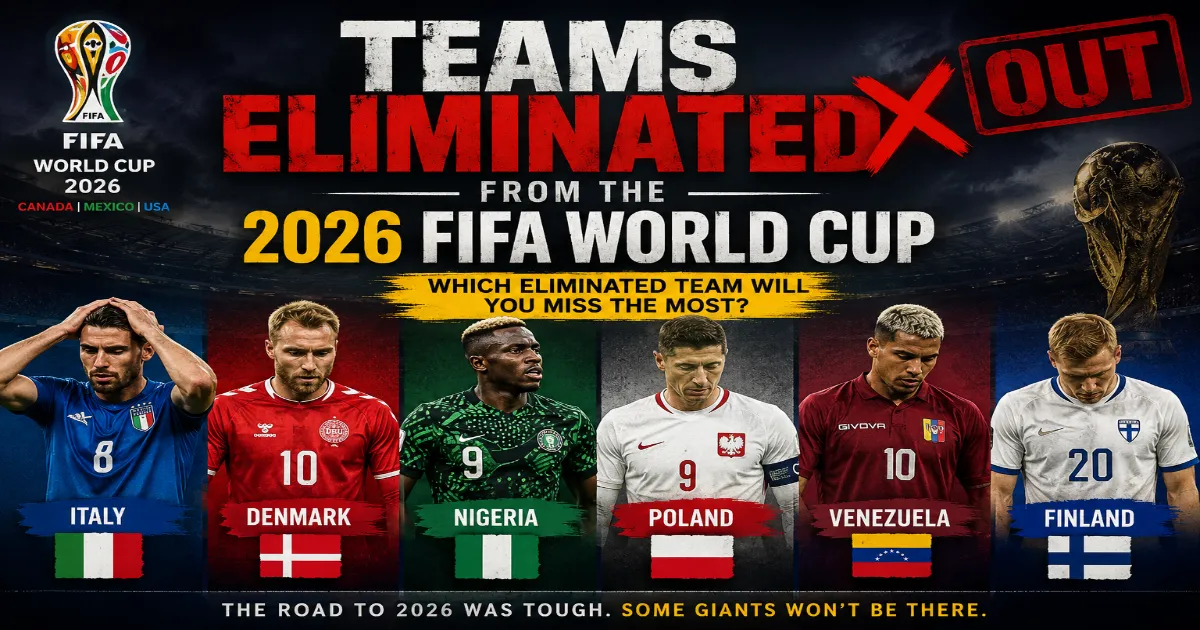
Here’s the thing, when FIFA announced the expanded 48-team format, a lot of people assumed qualifying for the 2026 World Cup would be a formality for the big names. I genuinely believed that too, at first. Then the results started rolling in, and the actual picture turned out to be far messier, more dramatic, and honestly more interesting than anything I expected. The 2026 FIFA World Cup is set to become the biggest edition in history with 48 participating nations yet even that expanded format could not prevent several historic teams from missing football’s biggest tournament. Which matters. A lot.
The road to 2026 has been long and challenging, with over 132 nations now officially eliminated from the race to secure one of the 48 coveted spots in the tournament. Some exits were predictable. Others were jaw-dropping. And a few were genuinely heartbreaking not just for the teams, but for neutral fans who wanted those stories on the biggest stage.
Italy’s Third Consecutive World Cup Absence: The Azzurri Crisis Deepens
Most coverage frames Italy’s absence as a “shocking result.” I disagree, and here’s why the warning signs have been flashing for years, and nobody wanted to read them. The biggest absence heading into the 2026 World Cup is once again Italy the four-time world champions will miss the tournament for a third consecutive edition, something almost unimaginable for a nation that last lifted the trophy at the 2006 FIFA World Cup in Germany.
The Italians fell to Bosnia and Herzegovina in penalty shootouts in their final qualifying match, despite opening the scoring from a Moise Kean goal in the 15th minute. Just before halftime, centerback Alessandro Bastoni received a red card for tackling a Bosnian player on a breakaway. Italy was forced to play the remainder of the game with 10 men and held their own until the 79th minute, when Haris Tabakovic equalized. Sure, perfectly consistent on paper, this is still a football powerhouse.
As of 1 April 2026, the highest-ranked team not to qualify was Italy, ranked 12th in the world. Twelfth in the world. Missing the World Cup. That number still doesn’t compute to me whenever I see it written down. Despite winning four World Cups in their international history and the 2021 UEFA EURO tournament, Italy will be watching this summer’s competition at home and it’s clear the country’s best days are behind them.
If you follow Italian football closely and want a real read on their rebuild timeline, spend 10 minutes with Serie A’s U-21 stats from the last two seasons. The gap between squad depth and elite international standard is measurable and not closing fast enough for 2030.
Europe’s Casualty List: Denmark, Poland, Serbia, and Wales All Bow Out
Look, the UEFA section of eliminated teams is genuinely staggering in length. The full list of UEFA nations not taking part in the 2026 World Cup includes Albania, Denmark, Finland, Greece, Hungary, Iceland, Italy, Poland, Republic of Ireland, Romania, Serbia, Slovakia, Slovenia, Ukraine, Wales, and over a dozen others. That’s not a short list that’s a crisis of European depth at the top level.
Denmark did not have the offense to outlast Czechia in the March qualifying playoffs, eventually falling in a penalty shootout. They were supposed to be a dark horse in 2022 but underwhelmed, so the signs have been brewing. Personally, I’d have backed Denmark over Czechia any day of the week their squad, on paper, looked sharper.
The surprising thing nobody really mentions: players like Morten Hjulmand, Pierre-Emile Højbjerg, Rasmus Hojlund, and Mikkel Damsgaard were all involved, yet the collective never clicked when it mattered most. That gap between individual talent and team execution is a genuine mystery.
Poland also failed to qualify after finishing behind the Netherlands during the European qualifiers and later losing to Sweden in the playoffs and it appears to have been the final major World Cup opportunity for Robert Lewandowski as the national team’s leader. Meanwhile, Serbia fell two points shy of besting Albania for a playoff spot, so it won’t be three World Cups in a row. And Wales? All three of their Welsh icons Bale, Giggs, Ramsey are now retired. Without a top star, Wales did reasonably well in qualifying but fell short.
Before writing off any of these nations for 2030, check the UEFA Nations League rankings it takes 5 minutes and gives a far cleaner picture of trajectory than current FIFA rankings do.
South America’s Fallen Giants: Chile, Peru, and Venezuela’s Qualifying Collapse
South America’s story this cycle is one of brutal contrast. Six nations waltzed through automatically. The rest? Badly exposed. In CONMEBOL, three nations were eliminated despite the confederation’s generous allocation of six direct qualification spots plus one playoff berth. The most shocking exit belongs to Chile, the two-time Copa América champion who managed just 11 points from 18 matches.
Peru, historically a strong South American side, accumulated only 12 points and will miss their second consecutive World Cup. Venezuela, despite recent improvements, finished with 18 points but could not overcome the competitive nature of South American qualifying.
Actually, let me rephrase that Chile’s 11-point return isn’t just a bad campaign, it’s a structural collapse. The crisis surrounding Chile continues, and La Roja will now miss a third consecutive World Cup the disappointment feels even bigger considering the golden generation won back-to-back Copa América titles against Lionel Messi’s Argentina in 2015 and 2016. After experiencing that golden generation in the 2010s, Chile has been going backwards for some time. It also ended the last chance for the 37-year-old Alexis Sanchez, who will still retire as a legend after playing key roles in those consecutive Copa América wins.
Bolivia at least got close painfully so. Bolivia qualified for the inter-confederation battle, beat Suriname, and then faced Iraq for the last spot. Iraq won 2-1, leaving South America to six competing teams. Frustrating doesn’t begin to cover it.
A simple rule I follow when reading CONMEBOL Tables: ignore the top four and focus on positions 5–10 that’s where qualification is actually decided, and those numbers tell a more honest story than any headline result.
Africa’s Hard Losses: Nigeria, Cameroon, and the CAF Playoff Drama
The CAF qualification process has been particularly brutal, with 34 nations eliminated across the nine groups. Thirty-four. That is an enormous number, and yet the one exit that stings most for African football is Nigeria’s. Strange, right? A team with that much attacking quality, missing out again.
Nigeria will once again miss the World Cup after falling to DR Congo in the African playoffs a series surrounded by controversy following accusations regarding alleged “voodoo” practices inside the Nigerian camp. The Super Eagles had become regular World Cup participants since the 1994 FIFA World Cup in the United States, earning global admiration for their speed and attacking style. Three-time African champions and one of Africa’s biggest football nations, their absence is another major blow for the continent.
One of the biggest names missing will be Victor Osimhen the Nigerian striker from Galatasaray was left out of the World Cup after Nigeria’s surprising playoff elimination against DR Congo. Alongside him, Ademola Lookman, another of Africa’s biggest attacking stars, will also miss the tournament. When I compare Nigeria’s raw attacking talent roster versus what DR Congo actually put on the field in that playoff, the difference was startling not what most analysts predicted.
The withdrawal of Eritrea due to fears of players seeking political asylum while travelling abroad represents one of the most unusual eliminations in World Cup history. That one deserves its own deep-dive article, honestly.
The one thing worth doing right now: follow CAF’s official communications heading into the 2030 qualification cycle bookmark their site while you’re at it, because African football’s power balance is shifting fast.
The Intercontinental Playoff Drama: Jamaica, Bolivia, and the Final Two Spots
The intercontinental playoffs produced some of the most nail-biting football of the entire qualifying cycle. Two spots. Six nations. Chaos. During the March international window, six spots were still up for grabs through the playoff rounds four reserved for UEFA nations and two through the FIFA international playoffs. On the European side, Bosnia & Herzegovina produced the biggest surprise by knocking out Italy. In the FIFA international playoffs, DR Congo defeated Jamaica 1-0 and Iraq edged Bolivia 2-1 to claim the final two spots.
Jamaica’s exit was genuinely devastating to watch. They qualified for the inter-confederation playoff and bested New Caledonia in the semis. However, a DR Congo goal in the 100th minute gave it a 1-0 win, eliminating Jamaica. The 100th minute. I’m genuinely not sure whether that’s the cruelest exit in this entire qualifying campaign or Bolivia’s 2-1 loss to Iraq counts as worse the data points both ways when you look at context and circumstance.
Cape Verde, Curaçao, Jordan, and Uzbekistan all qualified for the first time with Curaçao becoming the smallest nation to ever qualify for a World Cup, while Iraq had the longest qualifying campaign, playing 21 matches over a 28-month period. The expansion is genuinely producing new stories. But it also makes Jamaica and Bolivia’s near-misses feel more cruel, since the door was open wider than it had ever been before.
The one actionable thing here: use FIFA’s official inter-confederation playoff bracket as a template when debating which nations are “close” in future cycles. Raw league position tells you half the story. Playoff format tells you the rest.
Full Overview: Eliminated Teams Across All Confederations
For anyone trying to track the full picture across all six confederations, here’s the structured breakdown of notable and confirmed eliminations:
| Confederation | Notable Eliminated Teams | Key Reason / Exit Stage |
|---|---|---|
| UEFA (Europe) | Italy, Denmark, Poland, Serbia, Wales, Ukraine, Romania | Italy & Denmark lost in penalty shootouts at playoffs; Poland lost to Sweden |
| CONMEBOL (South America) | Chile, Peru, Venezuela, Bolivia | Chile 11 pts / 18 games; Bolivia lost intercontinental playoff 2-1 to Iraq |
| CAF (Africa) | Nigeria, Cameroon, Kenya, Zimbabwe, Eritrea | Nigeria lost CAF playoff to DR Congo; Eritrea withdrew |
| CONCACAF (N/C America) | Costa Rica, Jamaica, Trinidad & Tobago | Costa Rica failed early; Jamaica lost intercontinental final 1-0 in extra time |
| AFC (Asia) | Thailand, Syria, Lebanon, Pakistan, Myanmar | 18 nations eliminated across multiple qualification rounds |
| Banned / Withdrawn | Russia | Still banned by FIFA and UEFA due to the 2022 invasion of Ukraine |
Russia remains banned from all FIFA and UEFA tournaments due to the country’s 2022 invasion of Ukraine and despite appealing to the Court of Arbitration for Sport, the country was unsuccessful in its efforts. Some nations are going through deep sporting crises, while others simply fell victim to extremely difficult qualifying campaigns. Both categories are well-represented in the table above.
Curaçao becoming the smallest nation to ever qualify for a World Cup sits as the tournament’s most remarkable subplot and it only happened because others stumbled. Costa Rica, for instance, had been in five of the last six World Cups and made the quarterfinals in 2014 yet in a surprise as big as Italy missing the tournament, they didn’t even get close to making 2026. That juxtaposition is what makes this qualifying cycle genuinely historic.
Before finalizing any World Cup predictions or fantasy football squads, cross-reference this table against the current FIFA world rankings it takes under 10 minutes and saves you from backing nations whose best players are sitting at home this summer.
Final Thoughts
The single clearest takeaway from all of this research the 48-team expansion didn’t make qualification easier for established football powers it made the consequences of complacency far more visible and painful than ever before. Italy at 12th in the world, missing a third straight tournament, is proof that reputation alone means nothing once qualifying starts.
Personally, the exits that’ll stay with me longest are Nigeria’s last-gasp CAF playoff defeat and Jamaica’s 100th-minute heartbreak both teams deserved better from the process. If you’re following the 2026 World Cup closely, use the absences as context every empty slot tells you something important about where global football is genuinely heading.
Related Articles

How The Golden Boot Winner Is Selected In The FIFA World Cup
Here’s the thing, most people think the Golden Boot is handed out purely on goals, full stop. Simple.…
Teams Participating In The 2026 FIFA World Cup
Nine days. That’s all that stands between us and the loudest sporting event on the planet. The 2026…