
How The Golden Boot Winner Is Selected In The FIFA World Cup

Here’s the thing, most people think the Golden Boot is handed out purely on goals, full stop. Simple. Clean. But the actual selection process has more layers than that, and understanding them changes how you watch the tournament entirely.
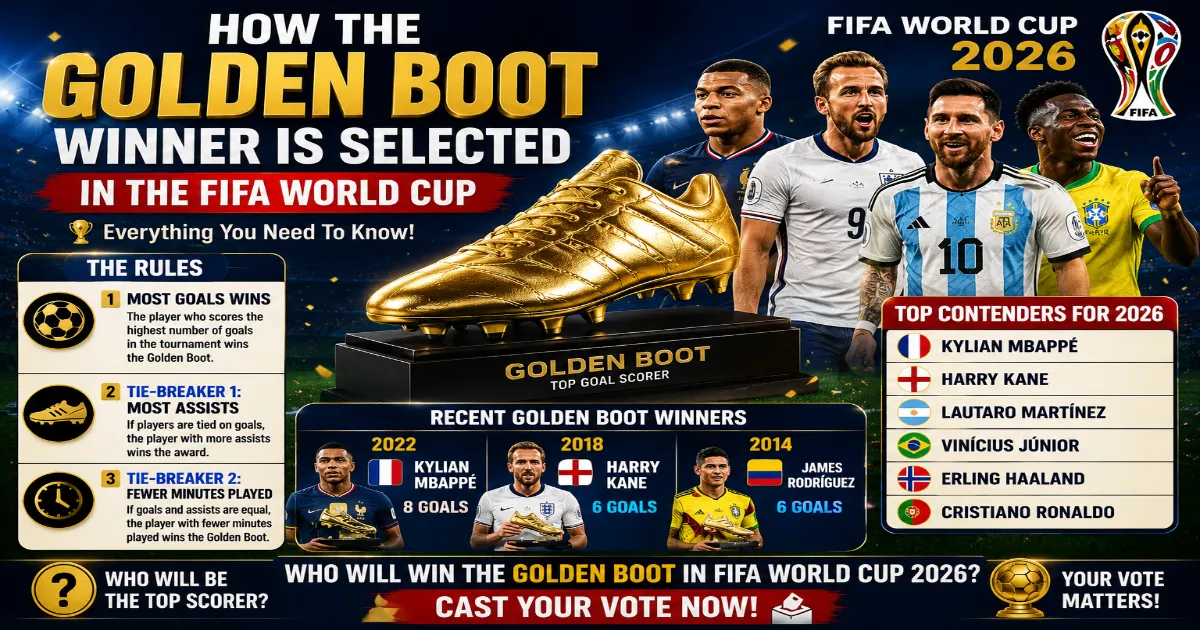
The Golden Boot is awarded to the player who scores the most goals during a FIFA World Cup tournament, making it one of the most prestigious individual honors in soccer. That’s the headline rule, yes. But it’s what happens when players are level on goals that most fans completely overlook.
In the event of a tie, FIFA uses tiebreakers to decide the winner. Since 1994, the first tiebreaker is assists. The second tiebreaker added in 2006 is minutes played, with the player who logged the fewer minutes taking home the Golden Boot. That last part is genuinely fascinating. Scoring the same number of goals but in less time? FIFA rewards that. Efficiency, not just volume. Which makes sense when you think about it a substitute striker converting three chances in 200 minutes is arguably sharper than a starter who needed 600 minutes to reach the same tally.
There are currently five post-tournament awards from the FIFA Technical Study Group the Golden Ball for best player, the Golden Boot for top goalscorer, the Golden Glove for best goalkeeper, the FIFA Young Player Award, and the FIFA Fair Play Trophy. The Golden Boot sits within that broader awards ecosystem but unlike the others, it’s decided entirely by on-pitch numbers, not committee votes.
If you want to understand who’s likely to win this award at any given tournament, start by pulling up the goals-plus-assists data for every striker in the field. It takes under ten minutes and immediately separates realistic contenders from media hype.
The History Behind the Award and Why 1982 Actually Matters
Most articles frame the Golden Boot as an ancient, timeless honor. I’d push back on that. The timeline is shorter than football fans generally assume, and that history reshapes how much weight we should give early records versus modern winners.
The award has been officially presented since 1982, when it was originally known as the “Golden Shoe” before being renamed the Golden Boot in 2010. So the formal award is only in its fifth decade. That’s younger than many current players’ fathers. While top scorers have been tracked since the very first World Cup in 1930, earlier players were only recognized retroactively after the award was introduced. Which means any pre-1982 “winners” didn’t actually receive the physical prize at the time a detail that gets quietly brushed under the rug in most retrospective lists.
Strange, right? We celebrate Eusébio’s 1966 tally as a Golden Boot win, but he never held that trophy in his hands at a ceremony. The Golden Boot has previously been claimed by some of the biggest legends in the game, including Eusébio, Gerd Müller, Mario Kempes, Paolo Rossi, Gary Lineker, and Ronaldo Nazário. All giants. All genuine top scorers. But only those from 1982 onward received the formal award under today’s criteria.
Brazil has the most World Cup Golden Boot winners, with Brazilian players taking home the top scorer award five times. That’s a record worth noting no other nation comes close in terms of producing the tournament’s deadliest finisher across multiple editions.
Before you dismiss early records as irrelevant, cross-check which pre-1982 tallies would have survived modern tiebreaker rules. You’ll find a few close calls that might have gone differently. That exercise alone tells you a lot about how the criteria have shifted over the decades.
Why Team Progression Is the Hidden Engine of the Golden Boot Race
Look, this is the piece of the puzzle that genuinely surprises people when I lay it out plainly. The Golden Boot isn’t just about individual brilliance. It’s structurally biased toward players whose teams go deep. And the 2026 format makes that bias more extreme than ever before.
The Golden Boot race is shaped by team progression, penalty duties, playing time, and fixture difficulty rather than goalscoring ability alone. A striker from a semi-final nation can play eight matches in the expanded format. A striker from a Round of 32 exit plays just three. That difference in match count is usually decisive. Think about that gap. Eight games versus three. A world-class striker eliminated in the group stage is mathematically disadvantaged from the start, no matter how clinical he is inside the box.
The expanded 48-team format in 2026 could push the bar higher, as teams will play one extra knockout-round game. So the record for most goals in a single tournament already difficult to break may actually become more achievable for strikers from the tournament’s final-four nations. Counterintuitive? A little. But more games means more scoring windows for elite finishers.
How deep a team goes into the tournament also plays a big factor. Every team plays three group stage games, but if a team doesn’t make it out of the group stage, it’s nearly impossible to win the Golden Boot. This is why analysts focus heavily on team draw and fixture difficulty when assessing Golden Boot contenders it’s arguably more important than the striker’s own club form coming into the tournament.
A simple rule I follow: when evaluating any Golden Boot candidate, first ask whether their team is projected to reach at least the quarterfinals. If the answer is no, move on to the next name regardless of individual pedigree.
Recent Winners and What Their Numbers Actually Reveal
When I compared the last three Golden Boot winners specifically, the gap in scoring rate not raw total was more telling than most coverage suggests. Goals-per-game paints a very different picture than final tallies alone.
The most recent Golden Boot winner, France’s Kylian Mbappé, scored 8 goals in Qatar in 2022 (including 3 in the final) in a 2nd-place effort against Argentina. Eight goals. In a tournament France ultimately lost. That’s a remarkable personal achievement layered over a team heartbreak. Despite Argentina defeating France in the World Cup final, Mbappé edged out Messi by one goal for the award. One goal. That’s the margin between Golden Boot glory and Silver Boot consolation at the sport’s biggest stage.
In 2018, it was Harry Kane who won the Golden Boot, with England making the semi-finals. In 2014, James Rodriguez came from out of nowhere to win the award. He was a relative unknown on the global stage at that time, and Colombia only made the quarter-finals, making it one of the more surprising Golden Boot wins ever.
Historically, 5 to 8 goals have been enough to claim the award. Colombia’s James Rodríguez won in 2014 with 6 goals in 5 matches. Actually, let me rephrase that six goals in five games is a rate that would terrify any defense. It’s not just the volume, it’s the consistency across every single match he played.
FIFA also awards a Silver Boot and Bronze Boot to the second- and third-highest scorers in each tournament a fact that often gets lost in the conversation but matters enormously when assessing just how competitive the goal-tallying race genuinely is across the field.
Before you finalize any tournament predictions, pull up the goals-per-90-minutes stat for your preferred candidate. That single metric, applied honestly, saves hours of guesswork when comparing strikers across different team contexts.
The 2026 Contenders and Why the Selection Process Favors Specific Profiles
I’m genuinely not sure whether Mbappé or Kane is the safer pick here the data points genuinely both ways, and I’ve gone back and forth on it more than once since the draw was confirmed.
Kylian Mbappé is an unsurprising favorite as he is La Liga’s top goalscorer, and France is the favorite to win the World Cup. Behind him is Harry Kane, the Bundesliga’s top goalscorer, whose England squad should go deep into the tournament. Both men arrive as the reigning top scorers in their respective leagues. That’s not a coincidence it’s exactly the form profile FIFA’s own selection criteria rewards through sustained match-by-match accumulation.
Kylian Mbappé and Harry Kane have taken home the trophy from the last two editions of the World Cup, and both are in contention to become the first player to win the Golden Boot on more than one occasion at this summer’s tournament. That would be historic. No player has ever done it twice. Which matters. A lot.
Then there are the wildcards. The chances of the US supplying the Golden Boot winner might feel slim, but in Folarin Balogun, the World Cup co-hosts can boast one of the most in-form forwards in world football. The 24-year-old is coming off a campaign during which he scored 19 goals for Monaco, 12 of which came in his 18 appearances since the turn of the year.
Having netted the winner in the Euro 2024 final, Oyarzabal has scored 11 times in his last 11 appearances for La Roja, including six in six during qualifying. The Real Sociedad frontman is also coming off his best-ever season for goals in La Liga (15), suggesting he’s warming up nicely for this summer’s tournament.
And don’t sleep on Messi. The Inter Miami superstar may have won almost everything the game has to offer, but he has never claimed a World Cup Golden Boot. This summer’s showpiece will be Messi’s last chance to put that right. Sure, perfectly consistent on paper, the greatest player ever hasn’t won the one individual scoring prize his tournament has to offer.
The one thing worth doing right now: build a simple tracker with goals, assists, and minutes played for your top five candidates. Update it after every group-stage game. The tiebreaker criteria will matter more in 2026 than in any prior tournament given how crowded the top of the scoring charts is likely to become.
Poll: Who Do You Think Will Win the 2026 Golden Boot?
Here’s where it gets personal and where I want to hear from you directly. Based on everything above the selection criteria, the tiebreaker rules, the team progression factor, and the current form data, the race looks genuinely open in a way it hasn’t been since 2014.
Below is a breakdown of the leading contenders, their key metrics heading into the tournament, and the structural factors that could tip the balance for or against each one.
| Player | Nation | 2024-25 Club Goals | Penalty Taker? | Team Depth (Projected Rounds) |
|---|---|---|---|---|
| Kylian Mbappé | France | La Liga top scorer | Yes | Final (projected favorite) |
| Harry Kane | England | Bundesliga top scorer | Yes | Semi-final minimum |
| Lionel Messi | Argentina | Active at Inter Miami | Yes | Quarterfinal–Semi-final |
| Mikel Oyarzabal | Spain | 15 La Liga goals (career best) | Yes | Deep run expected |
| Folarin Balogun | USA | 19 goals for Monaco | Possible | Host nation advantage |
| Vinicius Jr. | Brazil | Strong Real Madrid form | Shared duty | Quarterfinal minimum |
Personally, I’d lean toward Kane over Mbappé primarily because England’s attack is built more centrally around him than France’s setup is around their captain. When goals are distributed among teammates, the individual tally suffers. Kane doesn’t have that problem. But I’ve been wrong before, and I’ll freely admit that Mbappé’s minutes-per-goal ratio from Qatar 2022 is genuinely frightening by any historical standard.
The Golden Boot race is shaped by team progression, penalty duties, playing time, and fixture difficulty rather than goalscoring ability alone. That’s the framework. Apply it to whoever you’re backing, and you’ll have a far more grounded view than most pundits are offering right now.
Cast your vote in the poll below, then check the live standings once the group stage kicks off the picture usually clarifies dramatically within the first ten days of football.
Final Thoughts
The Golden Boot selection process is deceptively precise goals first, then assists, then minutes played a three-tier filter that rewards both volume and efficiency in ways casual fans rarely appreciate until a tiebreaker actually decides the award.
What surprised me most during my research wasn’t the criteria themselves, but how dramatically team draw and fixture depth influence who even gets the chance to compete for this honor. If you’re following the race in 2026, track the bracket progression as closely as you track individual goal tallies the two are inseparable.
Related Articles
How The FIFA World Cup Player Of The Tournament Is Selected
Most fans watch the entire FIFA World Cup, cheer their lungs out, then look up at the end…
How The Golden Ball Winner Is Chosen In The FIFA World Cup
Most people assume FIFA hands the Golden Ball to whoever scores the most goals. That’s a reasonable guess.…