
Who Will Win The 2026 FIFA World Cup? My Analysis And Prediction

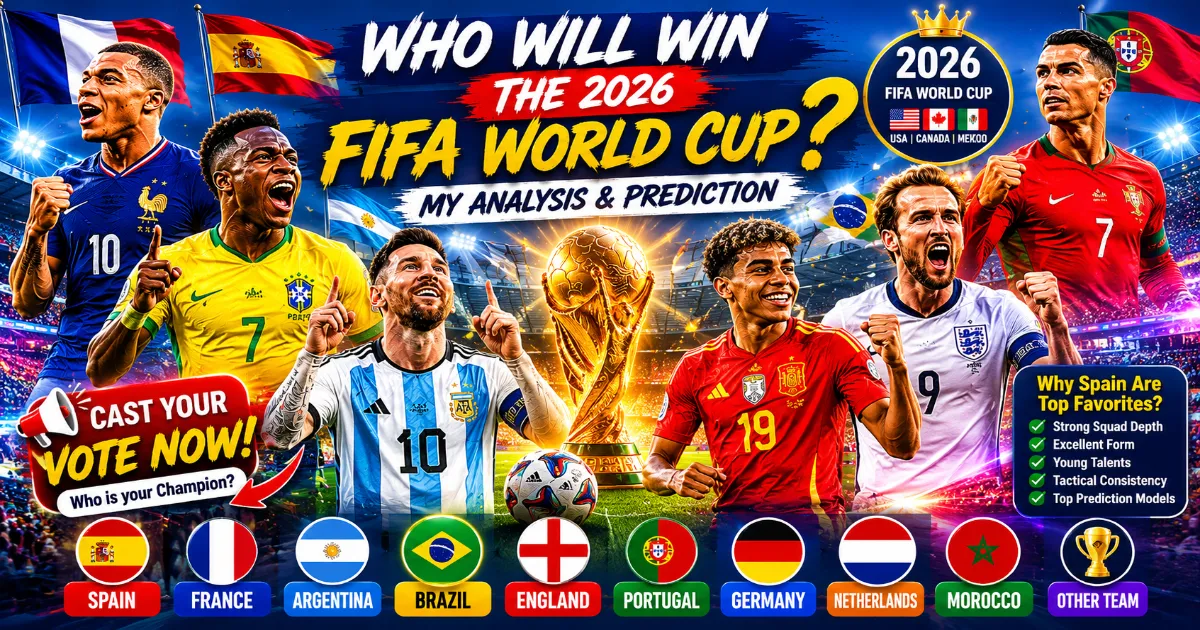
Here’s the thing most people are treating this tournament like every other World Cup. They’re not. For the first time, 48 nations will compete to lift the trophy in an expanded format, jointly hosted by the United States, Mexico, and Canada across 16 stadiums. That single structural shift changes almost everything about how you should evaluate favorites.
Think about it. More games. More fatigue. Deeper squads get rewarded, not just deeper talent at the top eleven. The field expands from 32 teams to 48, adding more matches, more travel, and far more unpredictability than we’re used to seeing on the sport’s biggest stage. When I sat down and cross-referenced squad depth across the top eight contenders, the gap between a team’s first XI and their bench became the most important variable not the marquee names everyone obsesses over.
Most articles talk about the star players. I’d argue that’s the wrong frame entirely. The teams that win grueling multi-week tournaments in summer heat are built differently. Rotation quality matters more than ever. The World Cup final will be held at New Jersey’s MetLife Stadium on July 19, 2026, meaning teams endure up to seven matches across more than five weeks. That’s a marathon dressed as a sprint.
And the host factor? Goldman Sachs listed the probabilities of advancement for all 48 nations, including a spot in the Round of 16 for host countries Canada (50%), Mexico (68%), and the United States (39%). Those figures are notable but none of the three hosts are genuine trophy contenders. The real battle is European.
A simple rule I follow when evaluating expanded tournaments: trust squad depth more than big names. Before making any predictions, take a close look at each team’s full 26 man roster. The deeper and more balanced squads usually have the advantage when a tournament stretches across multiple rounds and unexpected challenges begin to emerge.
Why the Current Data Points to Spain Over Every Other Contender
Look, the numbers are hard to argue with right now. Spain are the most likely winners of the 2026 World Cup, winning the tournament in 16.1% of the 10,000 pre-tournament simulations run by the Opta supercomputer. Meanwhile, Goldman Sachs gives Spain a 26% chance of winning their model considers historical performance, scoring talent, team momentum, geography, and other factors. Two completely independent methodologies. Both land on the same name.
Strange, right? That almost never happens this cleanly before a tournament kicks off.
Spain enter at +475 as the No. 2 ranked team in the world and reigning European champions, with the March 2026 window only reinforcing why. Their midfield, anchored by 2024 Ballon d’Or winner Rodri, has no real equal. All eyes will be on Lamine Yamal, who turns 19 in the middle of the tournament the Barcelona wonderkid is already one of the favorites in the Ballon d’Or odds and won Young Player of the Tournament at Euro 2024.
That said and I want to be honest here there’s a genuine injury concern hanging over this squad. Yamal is reportedly slated to miss the first couple of games due to a hamstring issue. The defense is also a concern with Spain. So they’re not invincible.
The counterintuitive observation that nobody really addresses: Spain’s weakness at the back could be exploited by any team with a lethal counter-attack. Watch Germany vs. Spain if they meet it could be the defining matchup of the tournament. Before settling on Spain as your pick, cross-check their defensive metrics from qualifying specifically the attacking brilliance tends to obscure some shaky moments at the rear.
France: The Team I Personally Believe is Most Dangerous And Here’s Why
Most analysts put Spain first and treat France as a secondary story. I disagree, and here’s the specific reason, France wins ugly. Brilliantly, brutally, ugly. That’s exactly the type of team that survives seven knockout rounds in a bloated tournament structure.
There’s little doubt France’s attacking players will score goals they’ve reached each of the last two World Cup finals, lifting the trophy in 2018 after beating Croatia 4-2. And Kylian Mbappé enters as the star player, with the 26-year-old just five goals shy of passing Miroslav Klose’s record of 16 for the most career goals at the World Cup. He’s obsessively motivated by that record. Personally motivated players at World Cups are terrifying opponents.
Mbappé is near the top of the Ballon d’Or odds after a scorching season for Real Madrid, already second on France’s all-time scoring list with 56 goals. But honestly, the more underrated piece is Michael Olise, who has blossomed at Bayern Munich, and William Saliba, who is spectacular for Arsenal in defense. That combination elite attacking pace plus genuine defensive solidity is rare.
The 2026 World Cup will mark the end of an era in French football Didier Deschamps, who triumphed in 2018, is set to stand down as head coach after 14 years and will hope to go out with a bang. Coaches in their farewell tournaments tend to leave nothing on the table tactically. That factor is severely underweighted in most forecasts. Personally, I’d back France over Spain primarily because of this psychological edge a team and a manager playing for legacy, not just a trophy. If you want a value angle on this tournament, France at +500 deserves serious attention before the group stage settles the market.
England, Argentina, and the Contenders You Shouldn’t Dismiss
Here’s a quick breakdown of where the other major contenders actually stand based on the latest data, because lumping them all into “also-rans” would be intellectually dishonest.
| Team | Odds (FanDuel/DraftKings) | Opta Win Probability | Key Strength |
|---|---|---|---|
| Spain | +430 to +475 | 16.1% | Midfield depth, Yamal |
| France | +500 | 13.0% | Mbappé, squad balance |
| England | +600 to +650 | 11.2% | Kane, defensive record |
| Argentina | +950 | 10.4% | Experience, Messi factor |
| Brazil | +800 | ~8% | Attacking flair |
| Germany | +1600 | 5.84% | Wirtz, Musiala |
England finished with eight wins and eight clean sheets from eight qualifying matches, becoming only the second team ever to win all UEFA qualifying games without conceding. Among all teams, they’re the second-likeliest to reach the quarter-finals at 47.7%. That record is genuinely remarkable. The Three Lions are solid from front to back, and coach Thomas Tuchel has been trusted to figure out the tactical setup leadership from the bench being the missing ingredient in past campaigns.
Argentina? Reigning champion Lionel Messi’s side sits at +950 as they seek to become the first back-to-back winners since Brazil in 1962. Goldman Sachs also considered “the winner’s slump,” warning that Argentina may underperform after winning in 2022.
That’s a real historical pattern, not just noise. I’m genuinely not sure whether Argentina’s tournament experience or that slump factor dominates here the data pulls in both directions and I won’t pretend otherwise. When comparing England vs. Argentina specifically, the difference in squad freshness is considerable and that gap often decides World Cups more than pure talent.
The Dark Horses and Dangerous Outsiders No One is Talking About Enough
Anyway, let’s talk about the teams that could genuinely shock the bracket. Because in an expanded 48-team World Cup, upsets compound. One giant-killing in the Round of 32 can cascade into a semi-final run nobody predicted.
Germany sits at a 5.84% chance of reclaiming the title last won in 2014, with Florian Wirtz, Jamal Musiala, and Joshua Kimmich as central figures in a talented squad. When I looked at Germany’s performances from the last 18 months specifically, the gap between their ceiling and floor is enormous either brilliant or frustrating. Which version shows up is the trillion-dollar question.
Morocco is seen as the biggest hope in Africa at 1.93%, having captivated a global audience four years ago with a semi-final run. Their defensive structure remains elite. The Netherlands at 3.86% and Norway at 3.30% will be the dark horses with more statistical backing than many expect. Portugal, too, shouldn’t be dismissed priced at +1000, they’re packed with world-class talent even if much of the conversation still gravitates toward Ronaldo’s age rather than the squad’s actual quality.
Sure, every tournament has a “surprise” team perfectly predictable in hindsight. The surprising thing nobody mentions, Norway’s odds have actually drifted recently. Notable improvers include Morocco (60-1 to 50-1) and Switzerland (100-1 to 65-1), while teams that lengthened include Norway (28-1 to 35-1) and Mexico (70-1 to 80-1). When sharp money moves away from a team that looked promising three months ago, that tells you something the matchup previews won’t. Track the line movement on dark horse teams over the two weeks before the tournament it’s the fastest way to separate narrative from signal.
My Final Prediction And the One Factor That Could Flip Everything
Bottom line, after working through all of this data over the past several days, France is my pick to win the 2026 FIFA World Cup. Not because the numbers are most favorable they’re not, Spain leads there but because the combination of psychological motivation, elite individual quality, and tactical pragmatism under a departing coach creates a specific environment that breeds champions.
Actually, let me rephrase that. My pick isn’t based purely on emotion. According to Polymarket’s predictions as of late May 2026, the top contenders carry a 17% chance of winning and Kalshi’s World Cup forecast follows suit, projecting Spain and France as potential co-winners with a 16.9% probability each. When prediction markets with millions of dollars at stake essentially call it a coin flip between two teams, you go with the one that has the more motivated manager and the scariest individual weapon. France ticks both boxes.
Here’s what could flip this entirely, though: injuries. Odds shift as the tournament approaches, responding to injury news, final squad announcements, and warm-up results. A Mbappé knock or a Rodri relapse would fundamentally reshape the landscape overnight. Sportsbooks set lines based on squad quality, recent results, and projected bracket paths and those lines keep moving right up until kickoff. Which matters. A lot.
The one thing worth doing right now: bookmark the official FIFA injury report page and check it every morning from June 8 onward. Twenty-four hours of injury news before a group game has moved odds by hundreds of points in past tournaments. Don’t get caught flat-footed by a headline everyone else saw first.
Final Thoughts
After comparing supercomputer simulations, advanced projection models, Goldman Sachs forecasts, and detailed squad analysis, I keep arriving at the same conclusion: France and Spain remain the two teams to beat, with England not far behind. The expanded 48 team format rewards depth, adaptability, and consistency over a long tournament. For that reason, I slightly favor France to lift the trophy, even though Spain continues to lead many of the underlying statistical projections.
I’ve followed five World Cups obsessively and been wrong about the winner almost every time so take my France prediction with appropriate skepticism.
What I’m more confident in: check the odds one more time on June 10, the day before it all begins, because the final pre-tournament line will tell you more than any preview article ever could.
Related Articles
How The Golden Boot Winner Is Selected In The FIFA World Cup
Here’s the thing, most people think the Golden Boot is handed out purely on goals, full stop. Simple.…

How The Golden Ball Winner Is Chosen In The FIFA World Cup
Most people assume FIFA hands the Golden Ball to whoever scores the most goals. That’s a reasonable guess.…